
Choosing the right water treatment is a huge decision for your business. The wrong choice can be costly. This guide will help you understand the difference between RO and UF.
Reverse Osmosis (RO) creates pure water by removing everything, including minerals. Ultrafiltration (UF) keeps the natural minerals in the water. The best choice depends on whether you want to produce pure water or mineral water for your brand.
Now you know the basic difference. But the details are what really matter for your production line, your costs, and the final taste of your water. There's a lot more to consider before you make a final investment. Let's dive deeper into each technology to see which one fits your specific business goals and how you might even use them together.
Is Reverse Osmosis the Best Choice for Pure Water Production?
Do you want to produce the purest water possible for your customers? But you might be worried about high energy costs or removing all the healthy minerals from the water.
Reverse Osmosis (RO) is the best method for creating highly purified water. It's perfect for products where absolute purity and consistency are most important. It uses a very fine membrane to remove almost all dissolved solids, salts, and contaminants.
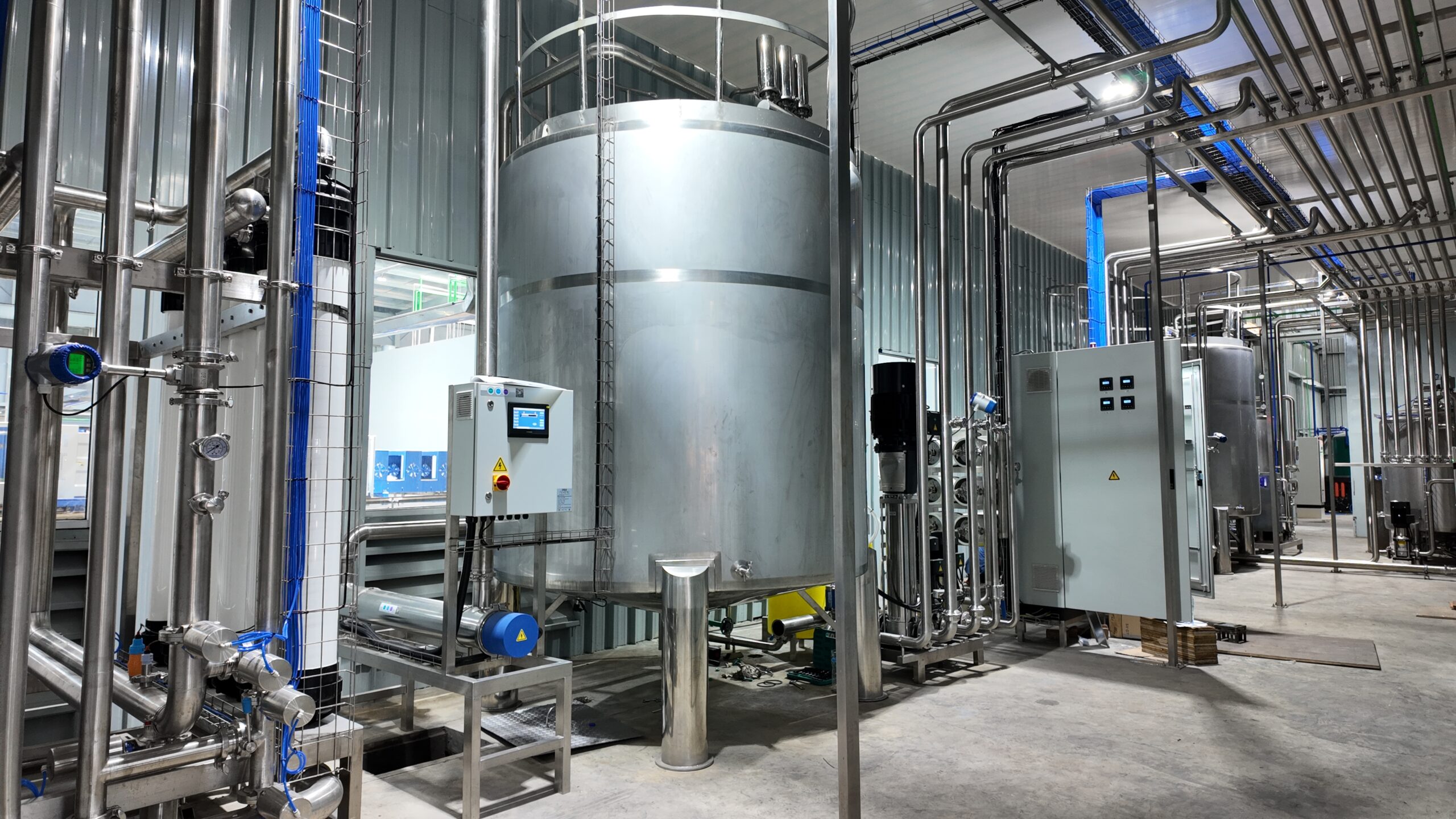
From my experience helping bottling plants in Indonesia, I know that RO is a powerful tool. It gives you complete control over your final product.
How RO Works
The process uses high pressure to push water through a semi-permeable membrane. This membrane has extremely small pores, around 0.0001 micron1. These tiny pores block almost everything that isn't a pure water molecule. This includes salts, minerals, heavy metals, bacteria, and viruses. The output is divided into two streams: the purified water (permeate) and the wastewater containing all the rejected contaminants (brine).
Pros and Cons of RO
This level of purification has both advantages and disadvantages for a business owner. It is important to understand them.
| Pros | Cons |
|---|---|
| Produces the highest purity water | Removes beneficial minerals |
| Removes viruses and bacteria2 | Higher energy consumption3 |
| Removes salts and heavy metals4 | Produces wastewater (brine)5 |
| Creates a consistent base for drinks | Higher initial investment cost |
Ultimately, RO is the standard when you need to be certain about your water's purity. It's ideal for creating a blank slate, which you can then sell as purified water or use as a base for adding specific minerals or flavors later.
Should You Choose Ultrafiltration for Natural Mineral Water?
Do you want to sell natural mineral water that tastes great and keeps its healthy minerals? But you need to be sure it is completely safe and free from harmful bacteria.
Ultrafiltration (UF) is the perfect choice for producing natural mineral water. It effectively removes harmful bacteria and particulates while preserving the essential minerals that give water its unique taste and health benefits, which customers love.
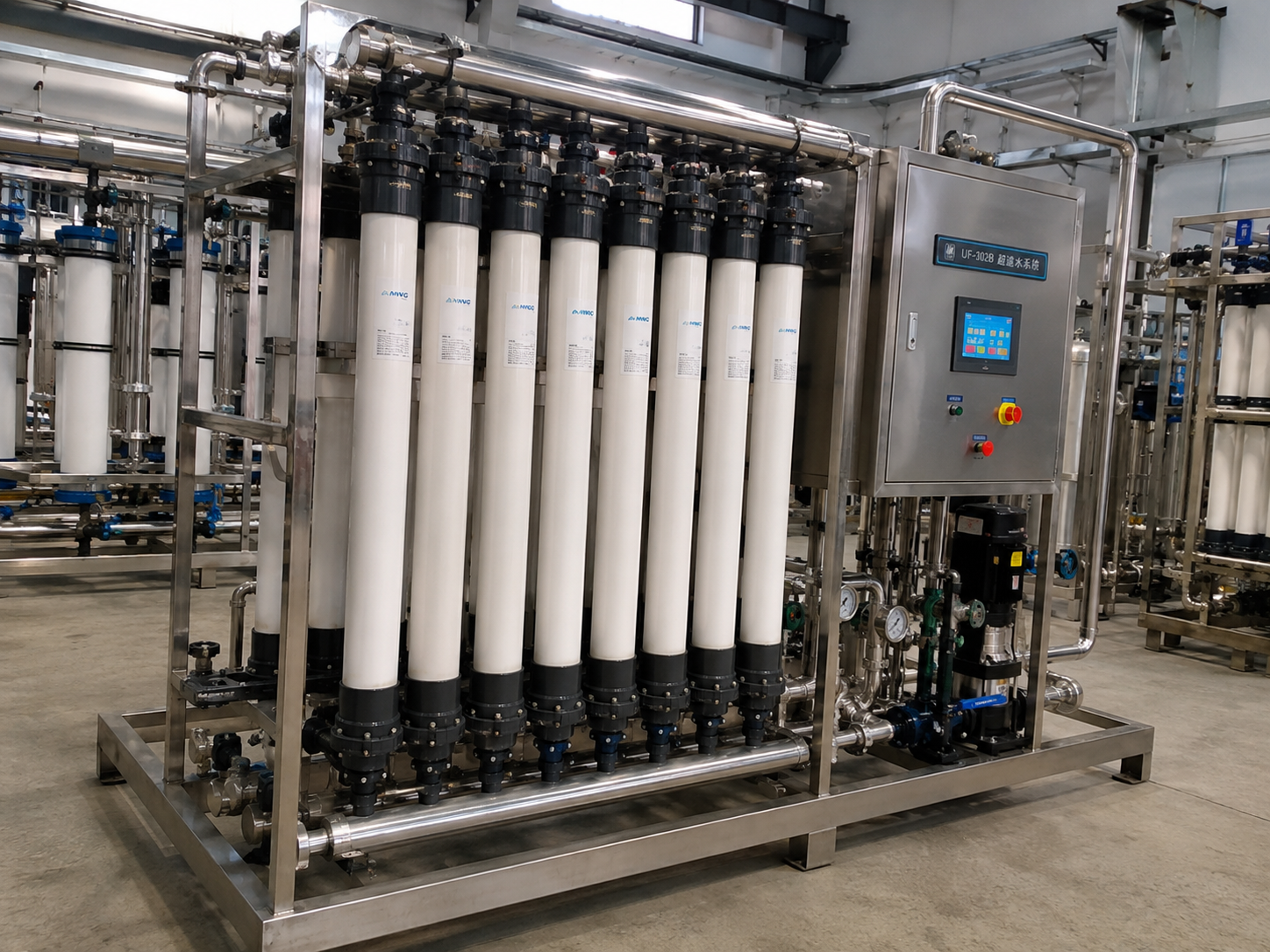
For many of our partners in Indonesia, UF is a very smart choice. It allows them to market their water as "natural" and "local," which is a strong selling point.
How UF Works
Ultrafiltration works differently from RO. It uses a membrane with slightly larger pores, typically between 0.01 and 0.1 micron6. It also operates at a much lower pressure. This means it uses less energy. Water flows through hollow fiber membranes, and these fibers trap suspended solids, viruses, and bacteria7. However, dissolved minerals and salts are small enough to pass through with the water molecules8.
Pros and Cons of UF
This technology offers a great balance between safety and nature, but it's not right for every situation.
| Pros | Cons |
|---|---|
| Retains natural, healthy minerals9 | Does not remove dissolved salts |
| Lower energy consumption vs. RO | Does not remove heavy metals10 |
| Less wastewater produced | Depends on good quality source water |
| Lower initial investment cost | May not be enough for very contaminated water |
If your source water is already of good quality and low in dissolved salts, UF is a very cost-effective way to produce safe, great-tasting mineral water11. It's a technology we have successfully installed for several clients who now have popular mineral water brands.
Can You Combine RO and UF for the Perfect Mineral Water?
What if you want the guaranteed purity of RO but also want the health benefits of mineral water? It might seem like you have to make a difficult choice between the two.
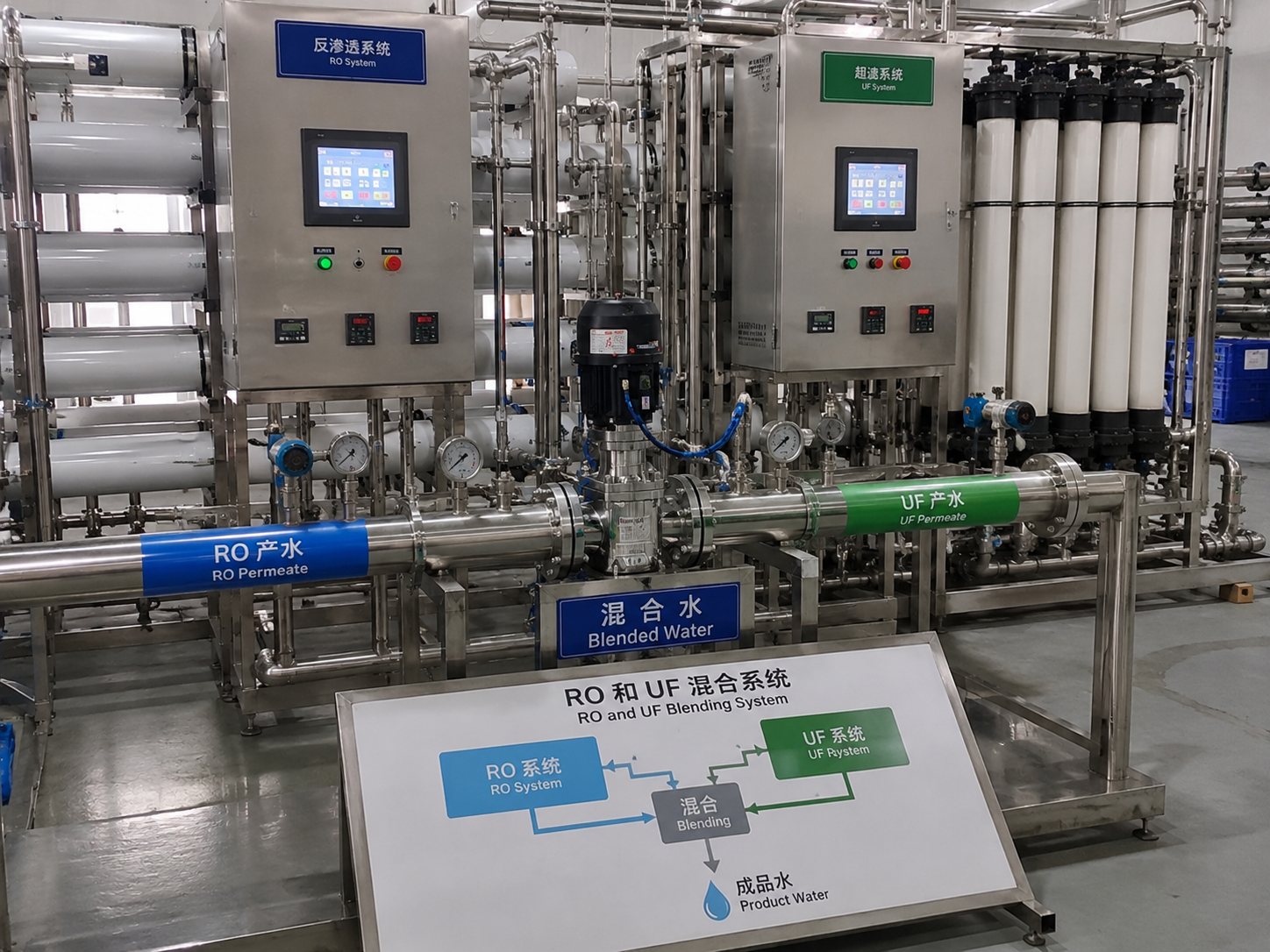
Yes, you can get the best of both worlds by combining RO and UF. A smart strategy is to blend water from both systems. This allows you to create a final product with a precise, consistent, and desirable mineral content.
This hybrid approach is an advanced solution that we've used to help clients create a truly premium product. It shows how engineering can solve marketing challenges.
The Blending Technique
Here is how it works. You split your raw water source into two streams. The first stream, maybe 70-80% of the total volume, goes through an RO system. This creates completely pure water. The second, smaller stream goes through a UF system. This water is safe and clean but still contains all its original minerals. Finally, you blend the two streams back together in a precise ratio. This allows you to control the exact Total Dissolved Solids (TDS) and taste profile of your final bottled water12. You get the purity and safety of RO with the desired mineral content for taste and health.
A Real-World Example
We recently helped a client in Indonesia with this exact challenge. They were building a new production line and needed a 30T/H water treatment system to launch their mineral water brand. Their source water was good, but they wanted a very specific mineral balance for the perfect taste. We designed and installed a system that uses this exact RO and UF blending technique. Now, they can produce millions of bottles of water that are not only safe but also have the exact taste profile that makes their brand stand out. This proves you can have both purity and minerals in a very controlled, high-tech way.
Conclusion
Choosing between RO, UF, or a combined system depends on your final product. Think about the water brand you want to build, and the technology will follow.
"Point-of-Use Reverse Osmosis Systems | US EPA", https://www.epa.gov/watersense/point-use-reverse-osmosis-systems. Reverse osmosis membranes are characterized by nominal pore sizes on the order of 0.0001 micron (roughly 0.1 nm), a specification documented in membrane filtration classification literature and used to distinguish RO from nanofiltration, ultrafiltration, and microfiltration. Evidence role: definition; source type: encyclopedia. Supports: The nominal pore size of reverse osmosis membranes, typically cited at approximately 0.0001 micron (0.1 nanometer), distinguishing RO from coarser membrane filtration technologies.. Scope note: Pore size values vary by manufacturer and membrane material; published figures represent nominal or approximate values rather than a single universal standard. ↩
"Point-of-Use Reverse Osmosis Systems | US EPA", https://www.epa.gov/watersense/point-use-reverse-osmosis-systems. The U.S. Environmental Protection Agency and World Health Organization guidance on membrane filtration document that reverse osmosis achieves high removal rates for bacteria and viruses, attributable to pore sizes smaller than the physical dimensions of these pathogens. Evidence role: mechanism; source type: government. Supports: That reverse osmosis membranes are effective at removing bacteria and viruses due to their sub-nanometer pore structure, achieving high log-reduction values for microbial contaminants.. Scope note: Actual removal efficiency depends on membrane integrity, system design, and operating conditions; published figures represent performance under controlled or ideal conditions. ↩
"Modeling the energy consumption of potable water reuse schemes", https://pmc.ncbi.nlm.nih.gov/articles/PMC8640112/. Peer-reviewed literature on membrane-based water treatment reports that reverse osmosis typically requires operating pressures of 5–70 bar and specific energy consumption of 0.5–3 kWh/m³ or more, substantially exceeding the energy demands of ultrafiltration, which operates at pressures below 5 bar. Evidence role: statistic; source type: paper. Supports: That reverse osmosis requires significantly more energy per unit of treated water than ultrafiltration, due to the higher operating pressures needed to overcome osmotic pressure across RO membranes.. Scope note: Energy figures vary widely by feed water salinity, system recovery rate, and the use of energy recovery devices; values cited in literature represent ranges across diverse operating conditions. ↩
"Removal of arsenic as a potentially toxic element from drinking ...", https://pmc.ncbi.nlm.nih.gov/articles/PMC10015207/. The U.S. Environmental Protection Agency and peer-reviewed water treatment literature document that reverse osmosis achieves rejection rates typically exceeding 90–99% for dissolved heavy metals such as lead, arsenic, and cadmium, attributable to the sub-nanometer pore structure of RO membranes. Evidence role: statistic; source type: government. Supports: That reverse osmosis membranes achieve high rejection rates for dissolved heavy metal ions including lead, arsenic, and cadmium.. Scope note: Rejection efficiency varies by specific contaminant, membrane type, pH, and operating conditions; some heavy metal species may require pre-treatment to achieve maximum removal. ↩
"Reverse Osmosis Concentrate: Physicochemical Characteristics ...", https://pmc.ncbi.nlm.nih.gov/articles/PMC8541667/. Regulatory and technical guidance documents, including those from the U.S. Environmental Protection Agency, describe the concentrate or brine stream as an inherent byproduct of reverse osmosis operation, typically representing 15–50% of feed water volume depending on system recovery rate. Evidence role: mechanism; source type: government. Supports: That reverse osmosis systems produce a concentrated reject stream (brine or concentrate) containing the dissolved solids removed from the feed water, which requires management or disposal.. Scope note: The proportion of brine produced relative to permeate varies significantly with system design, feed water quality, and recovery targets; figures cited are indicative of typical ranges. ↩
"Membrane Filtration Guidance Manual November 2005 - epa nepis", https://nepis.epa.gov/Exe/ZyPURL.cgi?Dockey=901V0500.TXT. Ultrafiltration is conventionally defined by membrane pore sizes in the range of 0.01 to 0.1 micron, a classification reflected in water treatment guidance documents published by agencies such as the U.S. Environmental Protection Agency and the World Health Organization. Evidence role: definition; source type: government. Supports: The accepted pore size range for ultrafiltration membranes, typically 0.01–0.1 micron, as defined within standard membrane filtration classification schemes.. Scope note: Exact boundary values differ slightly across classification systems; the range cited represents a widely used approximation rather than a single regulatory definition. ↩
"Low Pressure Membrane Filtration for Pathogen Removal - epa nepis", https://nepis.epa.gov/Exe/ZyPURL.cgi?Dockey=P10056FL.TXT. WHO and EPA guidance on membrane filtration for drinking water treatment indicates that ultrafiltration membranes with pore sizes of 0.01–0.1 micron reliably remove bacteria and protozoa; virus removal is also reported but is considered less consistent than in reverse osmosis, depending on membrane integrity and operating conditions. Evidence role: mechanism; source type: government. Supports: That ultrafiltration hollow fiber membranes can remove bacteria and, under certain conditions, viruses from water, though virus removal performance is more variable than for bacteria.. Scope note: Virus removal by UF is sensitive to membrane integrity; even minor defects can significantly reduce log-reduction values, making integrity testing a critical operational requirement. ↩
"Rejection Mechanism of Ionic Solute Removal by Nanofiltration ...", https://pmc.ncbi.nlm.nih.gov/articles/PMC8839881/. The size-exclusion mechanism of ultrafiltration membranes permits dissolved mineral ions (e.g., Ca²⁺, Mg²⁺, Na⁺) to pass into the permeate, as their hydrated radii are substantially smaller than the 0.01–0.1 micron pore range characteristic of UF membranes, a principle documented in membrane science literature. Evidence role: mechanism; source type: paper. Supports: That dissolved mineral ions and salts are not retained by ultrafiltration membranes because their hydrated ionic radii are smaller than UF membrane pore sizes, allowing them to pass freely into the permeate.. Scope note: While size exclusion is the primary mechanism, charge interactions and concentration polarization can also influence ion passage to a minor degree in some UF systems. ↩
"Calcium and magnesium in drinking water and risk of myocardial ...", https://pmc.ncbi.nlm.nih.gov/articles/PMC9535516/. A WHO report on nutrients in drinking water notes that calcium and magnesium present in drinking water can contribute meaningfully to dietary intake and that epidemiological studies have associated higher water hardness with reduced cardiovascular mortality, though the report cautions that evidence varies in quality across studies. Evidence role: general_support; source type: institution. Supports: That minerals naturally present in water, such as calcium and magnesium, may contribute to dietary intake and have been associated with health benefits in epidemiological research.. Scope note: The WHO report acknowledges that the health significance of minerals in drinking water remains an area of ongoing research and that the contribution of water minerals to overall dietary intake depends heavily on local dietary patterns and water consumption volumes. ↩
"Removal of Heavy Metals from Wastewaters and Other Aqueous ...", https://pmc.ncbi.nlm.nih.gov/articles/PMC11355994/. Technical literature on membrane water treatment confirms that ultrafiltration is ineffective at removing dissolved heavy metal ions such as arsenic, lead, and cadmium in their free ionic form, as these species are orders of magnitude smaller than UF membrane pores; removal of heavy metals by UF requires prior complexation or precipitation steps. Evidence role: mechanism; source type: paper. Supports: That ultrafiltration membranes do not effectively remove dissolved heavy metal ions because these contaminants exist in ionic form at sizes far below UF membrane pore dimensions.. Scope note: UF can remove heavy metals that are bound to particulate matter or colloids; the limitation applies specifically to dissolved ionic forms of heavy metals. ↩
"Modeling the energy consumption of potable water reuse schemes", https://pmc.ncbi.nlm.nih.gov/articles/PMC8640112/. Comparative analyses of membrane filtration technologies in drinking water production consistently report lower energy requirements and operating costs for ultrafiltration relative to reverse osmosis, owing to the lower transmembrane pressures required for UF operation. Evidence role: statistic; source type: paper. Supports: That ultrafiltration systems generally have lower energy consumption and operating costs per unit volume compared to reverse osmosis systems in drinking water production contexts.. Scope note: Cost comparisons are highly site-specific and depend on feed water quality, system scale, energy prices, and local labor costs; published figures should be treated as indicative rather than universally applicable. ↩
"[PDF] Total dissolved solids in Drinking-water", https://www.who.int/docs/default-source/wash-documents/wash-chemicals/total-dissolved-solids-background-document.pdf. The World Health Organization's guidelines on drinking water quality note that TDS affects the taste of water, with palatability generally considered good at TDS levels below 600 mg/L, acceptable up to 1000 mg/L, and increasingly unpalatable above that threshold, reflecting the sensory impact of dissolved mineral content. Evidence role: expert_consensus; source type: institution. Supports: That the total dissolved solids concentration in water, including mineral content, measurably affects consumer taste perception.. Scope note: Taste perception of TDS is subjective and varies by consumer population, cultural background, and the specific ionic composition of the dissolved solids, not TDS alone. ↩