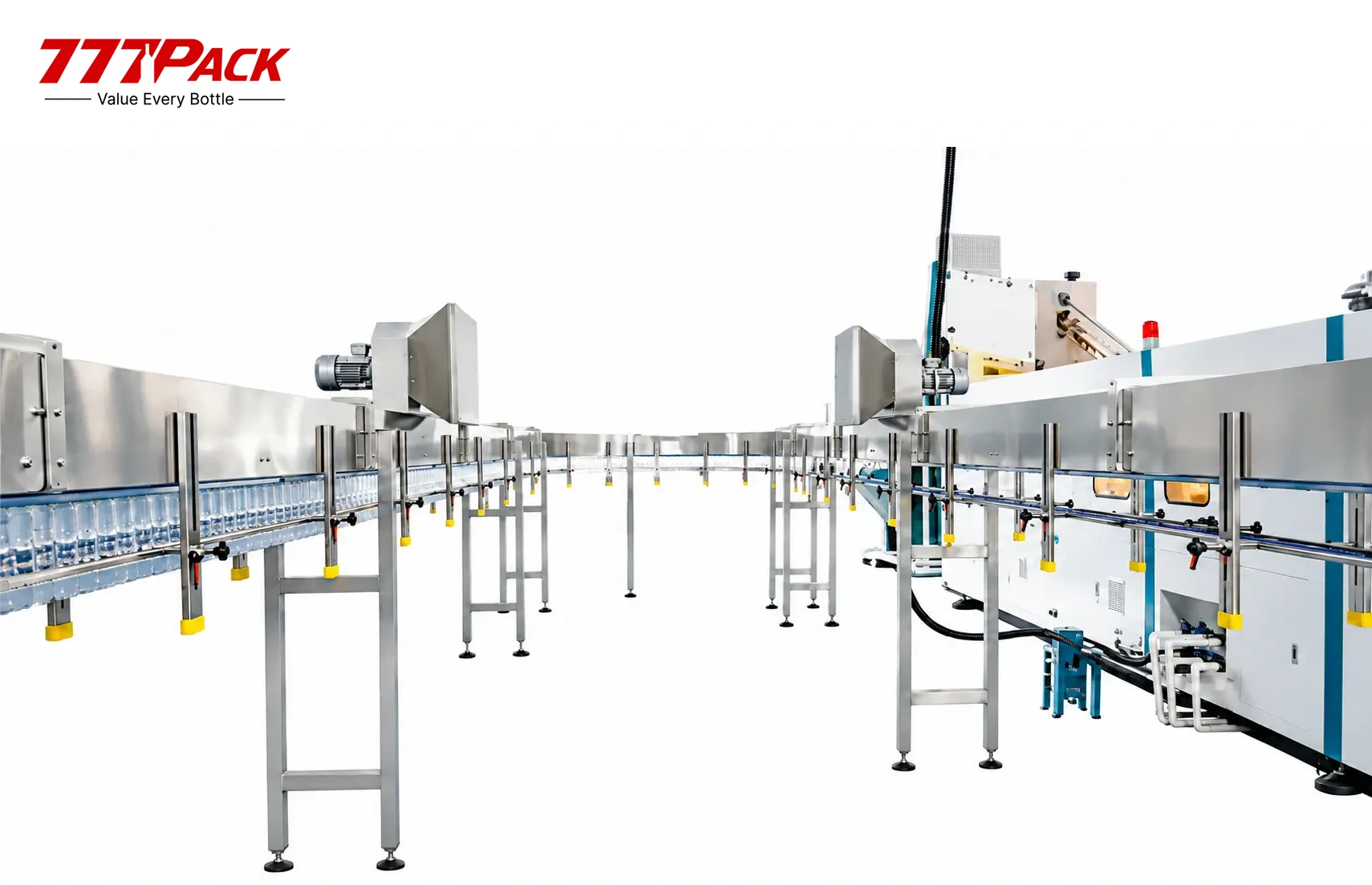
Air conveyor reference arrangement. The route, supports and machine interfaces follow the approved line layout.
Air Conveyor Systems for Empty PET Bottles
Transfer empty PET bottles between separate blow moulding and filling machines using directed airflow and neck-ring support. Bottle guides, airflow settings and transfer geometry are matched to the bottle format for smooth, stable flow.
Line integration
Position in the Production Line
The highlighted rail is the empty-bottle transfer system connecting the bottle blower to the filler.
CURRENT SYSTEMEmpty-Bottle Air ConveyingBlower outfeed → Filler infeedWater Treatment prepares the product water in parallel. Filled bottles move onward through drying, coding, labeling and packing using the separately selected downstream conveyor systems.
Reference connection only. Air conveyor scope covers empty PET bottle transfer from blower outfeed to filler infeed. Confirm bottle neck finish, route, air supply and machine interfaces for each project.
System Overview
An air conveyor carries empty PET bottles by their neck rings while directed airflow moves them toward the next machine. This support arrangement avoids carrying the bottle base on a moving chain or belt through the air-conveying section.
The system is typically used between an independent blow moulder and the filling-machine infeed. The guide arrangement and airflow must suit the bottle geometry, empty weight, route and line operating conditions. Neck rings remain in contact with their supporting guides; additional guidance is selected where needed.
Plan the Empty-Bottle Route with the Line
Define the route, transfer elevations, connection geometry and required response when the downstream machine stops. Airflow and bottle-flow control are developed around these conditions.
Explore our PET bottle blowing machines, PET bottle water filling machine and bottled water production lines. Our pre-sale engineering review brings the machine interfaces and conveyor layout together.
Choose the Right Conveying Task
Different products require different support, propulsion and machine interfaces.
| Empty PET bottle air conveying | Neck-ring support and directed airflow, typically between separate blow moulding and filling machines. This is the system described on this page. |
|---|---|
| Filled-bottle mechanical conveying | Bottle transfer on mechanically driven conveying surfaces after filling. See pressureless bottle conveyor systems for this separate handling task. |
| Bottle-cap feeding | Separate handling, orientation and delivery equipment matched to the closure and capper. Bottle caps are not conveyed on the neck-ring bottle track. |
In an integrated blow-fill-cap block, bottles normally transfer directly within the block, so a separate air conveyor is usually unnecessary. Confirm the actual machine architecture and project scope.
How PET Bottle Air Conveying Works
Neck-ring support and controlled airflow work together.
Handling Benefits
Engineering priorities for reliable transfer of lightweight empty PET bottles.
Stable empty-bottle handling
Support at the neck ringThe bottle is carried by its neck ring through the conveying section. Match the guides and clearances to the actual bottle to support stable flow.
A route suited to your factory
Connections · Elevations · AccessReview straight sections, directional changes, elevations and supports with the machine positions and available space. The final route follows the approved layout.
Coordinated machine supply
Airflow matched to line conditionsDefine how the air conveyor supplies the filler and responds to changing bottle flow. Operating settings and machine signals are agreed for the line.
Configuration & Selection Data
Specify the bottle, route and machine interfaces before finalizing the system.
| System function | Empty-PET-bottle transfer between the agreed upstream and downstream machines |
|---|---|
| Propulsion principle | Directed airflow supplied by fans |
| Bottle support | Neck-ring guides; additional guidance defined for the bottle format |
| Neck compatibility | Confirm neck finish, support-ring geometry and under-neck dimensions |
| Bottle format | Confirm height, body shape, empty weight and representative bottle samples |
| Required throughput | Specify normal and peak bottles/hour for the selected bottle formats |
| Route and installation | Approve lengths, curves, elevations, supports and maintenance access |
| Machine interfaces | Confirm blow-moulder discharge, filler infeed, transfer geometry and elevations |
| Controls and sensing | Agree airflow control, sensing requirements, status signals and stop/restart response |
| Air quality and hygiene | Specify air-source location, filtration, protection and cleaning provisions for the environment |
| Utilities and materials | Electrical load, supply, materials and any auxiliary pneumatic requirements follow the final configuration |
| Acceptance basis | Approved bottles, output, flow conditions, transfer behaviour and inspection criteria |
Line Interfaces
This system handles empty PET bottles before filling. In the example above, Air Conveying is the transfer link between Bottle Blowing and Filling; only this link is marked current.
After filling, bottles normally require a different conveying arrangement. Review the Conveyor Systems range for the other handling sections in the project.
- Blow-moulder discharge: Match the outfeed orientation, neck-handling geometry and transfer elevation. Review the selected PET bottle blowing equipment.
- Filling-machine infeed: Confirm the receiving geometry, bottle-entry conditions and speed requirement with the PET bottle water filling machine.
- Bottle-flow control: Document the required machine-status signals and the agreed response to downstream stops, upstream gaps, bottle build-up and restart.
- Factory installation: Coordinate supports, clearances, elevations and safe maintenance access. Identify every included section in the line layout.
Bottle & Neck Compatibility
Neck-ring support makes the neck drawing an essential input. A bottle’s nominal volume alone does not establish compatibility.
- Neck and support ring: confirm ring diameter, thickness, under-neck geometry and available support surfaces.
- Bottle body: review overall height, width, shape and empty weight, including any features that affect guide clearances.
- Guide arrangement: agree neck clearances and any body or shoulder guides needed for the approved formats.
- Format changes: identify required manual adjustments, change parts or other provisions in the final design. Check each format using representative samples.
The approved bottle range, settings and changeover requirements form part of the technical agreement.
Hygiene & Maintenance Planning
Air-quality planning
Specify the supply and filtrationReview the air intake environment, filtration requirements and protection around the bottle path. Define filter inspection and replacement requirements for the supplied configuration.
Cleaning access
Reach the air path and bottle guidesAgree access to the conveying channel, neck guides and other contact areas. Select cleaning methods for the materials, environment and equipment instructions.
Condition and settings checks
Keep guides and airflow in conditionInspect guide wear, alignment, airflow performance and bottle behaviour. Record approved settings and review changes when bottle formats or operating conditions change.
General background: EHEDG GL 8 — Hygienic Design Principles. Hygiene and cleaning provisions must suit the actual equipment and production environment.
Testing & Acceptance
Agree the bottle formats, operating conditions and inspection criteria before commissioning.
Bottle and neck checks
Representative production samplesCheck support-ring engagement, guide clearances, body stability and the transfer handovers for each approved bottle format.
Output and flow
Agreed operating conditionsRun the approved formats at the agreed line rate. Review bottle movement through the route and supply to the downstream machine.
Stops and restart
Coordinated line scenariosCheck bottle build-up, downstream stops, upstream gaps and restart with the selected control logic and airflow settings.
Installation and handover
Document the final configurationCheck supports, access, machine interfaces and cleaning provisions. Record format settings and provide the operating and maintenance information.
Frequently Asked Questions
Bottle support, sizing, airflow, hygiene and line integration.
Which containers is this system designed for?
This page covers empty PET bottles with a compatible neck ring. Confirm the neck drawing, bottle dimensions and empty weight. Glass bottles, filled containers, loose caps and other products require their own handling review.
How are the bottles supported during conveying?
The neck ring rests on supporting guides while airflow moves the bottle forward. The neck and guides remain in contact, and additional body or shoulder guidance may be needed. Handling quality depends on the bottle, clearances, settings and condition of the system.
Which neck finishes and bottle sizes can run?
Compatibility is established from the actual neck and bottle drawings and samples. Confirm the support ring, under-neck geometry, height, body shape and empty weight. The final specification lists the approved formats and required changeover adjustments.
How is conveying output specified?
Output is selected for the bottle range, route and connected machines. Provide normal and peak bottles/hour and the blow-moulder and filler operating requirements. The agreed performance is checked under defined conditions with representative bottles.
How are air quality and cleaning specified?
Air-source location, filtration, covers or protection, cleaning access and maintenance requirements are defined for the environment and final design. Air conveying is a transport function; it does not replace a specified bottle-cleaning or decontamination process.
How does conveying air differ from compressed air?
This type of conveyor uses fan-supplied airflow to propel the bottles. It is a different duty from the process compressed air used to form PET bottles. Any compressed-air requirement for auxiliary devices is specified separately in the final utility list.
How is an existing line reviewed for an air conveyor?
Provide the current layout, machine discharge and infeed details, transfer elevations, bottle drawings and target output. The review checks the route, supports, interfaces and control requirements. See our pre-sale engineering services.
What is required for bottle-cap feeding?
Caps need separate feeding and delivery equipment matched to the closure and capper. A neck-ring bottle conveyor is not a cap-feeding track. Identify cap handling as a separate scope item when requesting a complete line.
When is an independent air conveyor needed?
It is commonly used between separate blow moulding and filling machines. Integrated blow-fill-cap blocks normally transfer bottles directly within the block, so an independent air conveyor is usually unnecessary. Confirm the selected machine architecture.
What should I provide for a quotation?
Send bottle and neck drawings, representative samples, normal and peak output, factory layout, machine positions and connection elevations. Include hygiene requirements and the desired control interfaces. Request an air-conveyor layout review.
Project Services
Manufacturing & Line Integration
Core equipment manufacturing, auxiliary-machine coordination and complete-line integration are managed as one system to reduce interface risks before delivery.
FAT & Quality Inspection
Project checks before packing and delivery.
Installation & Commissioning
On-site setup, testing and operator training.
Local Support in Indonesia
Local coordination for service and spare parts.
Connect Your Blow Moulder and Filler
Send your bottle and neck drawings with the line layout so the route, guides and machine handovers can be reviewed together. Our after-sale services support installation, commissioning and operator training.