
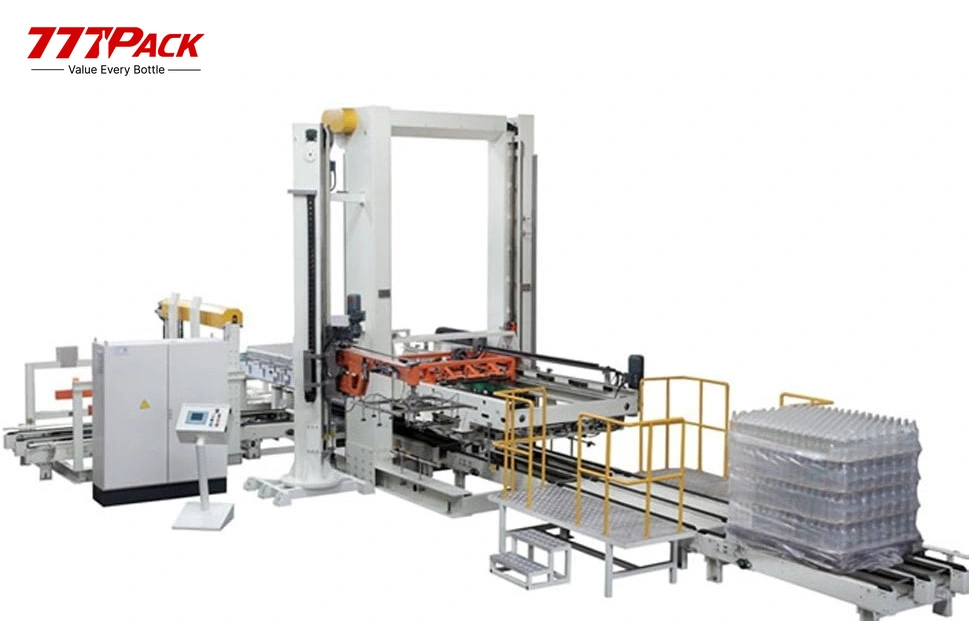
Automatic Low-Level Glass Bottle Depalletizer
After manual strap and film removal, this automatic glass bottle depalletizer clamps and transfers whole layers. Includes sheet collection and empty-pallet discharge. Reference ≥24,000 BPH; bottles 70–360 mm high.
Line integration
Position in the Production Line
The current stage is highlighted. This example shows how the equipment connects within the selected line.
- Parallel preparation01AWater TreatmentFilter · Purify · Disinfect01BDepalletizingUnload · Separate · FeedCURRENT
- 02FillingRinse · Fill · Cap
- 03DryingRemove Surface Moisture
- 04CodingDate · Batch · Traceability
- 05LabelingSleeve · Hot Melt · Self-Adhesive
- 06PackingFilm · Carton · Tray
- 07PalletizingStack Finished Packs
Swipe or scroll to explore all stages →
Reference flow only. Final process and equipment scope depend on the product, container, output and project requirements. Each stage links to its equipment or equipment category.
Equipment Overview
The Automatic Low-Level Glass Bottle Depalletizer unloads palletized empty glass bottles at the container infeed stage of a bottling line. A lifting platform positions each layer, and a clamping mechanism lifts and transfers the bottles to the bottle conveyor. Interlayer sheets are collected and empty pallets are automatically discharged and collected.
The reference configuration handles glass bottles 70–360 mm high at an output of ≥24,000 bottles/hour. Siemens PLC and touchscreen controls coordinate the sequence, with Schneider Electric drives and relays, SICK sensors and Airtac pneumatic components. Pallet dimensions are configured to customer requirements.
Forklift loading and manual removal of straps and wrapping film are part of the operating process. Final output and performance depend on bottle geometry, pallet pattern, layer count, interlayer condition, conveyor matching and agreed test conditions. Bottle diameter, pallet load and site utility requirements must be confirmed during project engineering.
Selection and Line Integration
For this low-level depalletizer, provide bottle drawings and samples, pallet dimensions, full-pallet weight, layer pattern and layer count, stack height and sheet details. Match the bottle transfer height, guide arrangement, conveyor speed and buffer capacity to the next inspection, rinsing or washing stage and the selected filler. Beverage preparation runs separately from the empty-container flow.
Browse our bottle and can depalletizing systems. For downstream planning, review the glass bottle water filling machine or glass bottle carbonated drink filling machine.
Request a Matched Configuration
Send your bottle and pallet specifications, target output, factory layout, downstream equipment, available utilities and project location through our project inquiry page. Include bottle conveyor height and any site constraints so the proposed empty glass bottle depalletizing arrangement can be assessed against your actual line.
Machine Details
Key Component Brands
Core Specifications
| System type | Automatic low-level glass bottle depalletizer |
|---|---|
| Reference production capacity | ≥24,000 bottles/hour |
| Glass bottle height | 70–360 mm |
| Main-machine dimensions (L × W × H) | 8500 × 3000 × 3200 mm |
| Machine weight (reference) | 6.5 tonnes |
| Total power (reference) | 7 kW |
| Power supply | Three-phase AC 380 V ±5%, 50 Hz |
| Pallet dimensions | Configured to customer requirements |
| Reference bottle toppling rate | ≤0.2 % |
| Reference bottle breakage rate | ≤0.3 % |
| Reference noise level | <75 dB |
| Pallet infeed buffer (reference) | Up to 2 pallet stacks |
Working Principle
Engineering Highlights
Practical design details that affect operation, changeover, hygiene and maintenance.
Whole-layer clamping and transfer
Clamp · Lift · TransferBottles are clamped and lifted as a layer, then transferred horizontally and released onto the outfeed conveyor.
Pallet infeed buffering
Up to 2 pallet stacks in the reference layoutThe reference infeed conveyor uses two double-row chains to buffer and convey full bottle pallets.
Interlayer collection
Integrated sheet collectionThe sheet transfer mechanism collects separating sheets at a dedicated stacking station.
Automatic empty-pallet discharge
Automatic discharge and collectionAfter all layers are unloaded, the platform lowers the empty pallet and the chain conveyor transfers it to the collection station for forklift pickup.
Line Integration
Line Integration
Equipment role and interfaces for this reference application.
Positioned at the empty-container infeed of a glass bottling line, this low-level depalletizer receives forklift-loaded pallets after manual removal of straps and wrapping film. It lifts the pallet stack, transfers each bottle layer by clamping and lifting, collects interlayer sheets, and automatically discharges empty pallets. The bottle outfeed conveyor connects to the line's specified inspection, rinsing or washing stage before filling and capping. Beverage preparation operates separately; glass bottles are supplied from pallets.
- Upstream pallet supply: Forklift loading and manual strap/film removal; confirm pallet dimensions, layer pattern, layer count and full-stack height.
- Bottle format and gripping: Reference bottle height 70–360 mm. Provide bottle drawings, samples, diameter, weight and neck/shoulder geometry for clamping and transfer assessment.
- Downstream bottle conveyor: Confirm discharge height, conveyor width, guides, buffer capacity and matched speed with the specified bottle inspection/rinsing/washing and filling equipment.
- Line control coordination: Agree ready/run/fault and bottle-accumulation signals, stop/start sequencing, guarding zones and emergency-stop interfaces during integration.
- Interlayer sheets: Confirm sheet dimensions, material, stiffness and condition for the collection mechanism and stacking station.
- Empty-pallet discharge: Automatic discharge and collection; reserve a clear collection position and forklift pickup route.
- Installation layout: Reference main-machine dimensions 8500 × 3000 × 3200 mm (L × W × H). Confirm floor loading, lifting clearance, access and maintenance space in the final layout.
Standard and Optional Configuration
- Pallet infeed conveyor
Two double-row chain conveyors buffer and transport pallet stacks; the reference layout can stage two full bottle pallets.
- Stack lifting platform
Motor-driven lifting raises the pallet stack to the unloading height and indexes it for successive bottle layers.
- Whole-layer bottle transfer and outfeed
The clamping mechanism lifts a full bottle layer, moves it horizontally and releases it onto the bottle conveyor for onward transport.
- Interlayer sheet collection
A sheet transfer mechanism collects separating sheets at the sheet stacking station.
- Automatic empty-pallet handling
The empty pallet is lowered, automatically discharged by the chain conveyor and collected for forklift removal.
- Controls and component package
Siemens PLC and touchscreen HMI; Schneider Electric variable frequency drives and relays; SICK photoelectric and proximity switches; Airtac cylinders and solenoid valves. Final component scope follows the agreed configuration.
Utilities and Installation
Electrical supply
Three-phase AC 380 V ±5%, 50 Hz; reference total power 7 kW.
Compressed air
Pneumatic cylinders and solenoid valves are included. Required pressure, air quality and consumption must be confirmed for the final configuration.
Site and handling access
Confirm floor support for the reference 6.5-tonne machine, lifting clearance, service access and forklift routes for full-pallet loading and empty-pallet collection.
Before You Decide
Frequently Asked Questions
Answers to common questions about selection, integration and project planning.
What is the reference output of this glass bottle depalletizer?
The reference configuration is rated at ≥24,000 bottles/hour. This is a reference production figure, not a confirmed maximum or an unconditional guarantee. Sustained output must be confirmed for the actual bottle, pallet pattern, layer count, sheet condition, conveyor matching and agreed test conditions.
Which glass bottles and pallet sizes can it handle?
The documented bottle-height range is 70–360 mm. Pallet dimensions are configured to customer requirements. Provide bottle drawings and samples, bottle diameter and weight, neck/shoulder geometry, pallet dimensions, layer pattern, layer count and full-stack height so the clamping and transfer arrangement can be checked. No bottle-diameter range or maximum pallet load is specified in the reference data.
Does fully automatic depalletizing include automatic film removal?
An operator removes the straps and wrapping film at the unpacking position. Forklift loading is also part of the process. The automatic sequence covers pallet conveying and lifting, interlayer collection, bottle-layer clamping and transfer, successive-layer unloading, and empty-pallet discharge and collection. A forklift removes the collected empty pallets.
How are the bottles transferred from each pallet layer?
A clamping mechanism grips and lifts the full bottle layer, moves it horizontally to the bottle conveyor and releases the bottles. The lifting platform then indexes according to the preset bottle height for the next layer. The documented mechanism is whole-layer clamping, lifting and transfer.
How does the depalletizer connect to a glass bottle filling line?
It supplies empty glass bottles from pallets to the bottle conveyor at the start of the container-handling line. The next inspection, rinsing or washing step must match the bottle condition and filling process. Confirm conveyor height, guides, buffering, speed and control signals with the selected filler. Explore the glass bottle water filling machine and glass bottle carbonated drink filling machine for downstream equipment planning.
Which control and pneumatic brands are included?
The reference configuration uses Siemens PLC and touchscreen HMI, Schneider Electric variable frequency drives and relays, SICK photoelectric and proximity switches, and Airtac cylinders and solenoid valves. Confirm the final component scope in the agreed technical configuration.
What electrical supply and installation space are required?
The reference supply is three-phase AC 380 V ±5%, 50 Hz, with total power of 7 kW. Main-machine dimensions are 8500 × 3000 × 3200 mm (L × W × H), and reference weight is 6.5 tonnes. The final layout must also allow service access, lifting clearance, sheet collection and forklift routes. Required compressed-air pressure and consumption are not specified and must be confirmed during engineering.
How should the bottle toppling, breakage and noise figures be evaluated?
The reference figures are a bottle toppling rate ≤0.2%, bottle breakage rate ≤0.3% and noise level <75 dB. These must be verified with the actual bottle quality and condition, pallet arrangement, operating speed, interlayer sheets and site setup. Agree the acceptance-test procedure, rate definitions and noise measurement conditions before testing.
What information should I send for a configuration and quotation?
Send bottle drawings or photos and samples; height, diameter, weight and neck/shoulder geometry; pallet size and full-pallet weight; layer pattern, layer count, stack height and sheet details; target BPH; downstream equipment and conveyor height; factory layout, available utilities and project location. Use the project inquiry page to request a matched configuration.
Project Services
Manufacturing & Line Integration
Core equipment manufacturing, auxiliary-machine coordination and complete-line integration are managed as one system to reduce interface risks before delivery.
FAT & Quality Inspection
Project checks before packing and delivery.
Installation & Commissioning
On-site setup, testing and operator training.
Local Support in Indonesia
Local coordination for service and spare parts.
Let us match the right equipment solution.
Send these four project details. We will recommend the technology, output configuration and line connection plan.