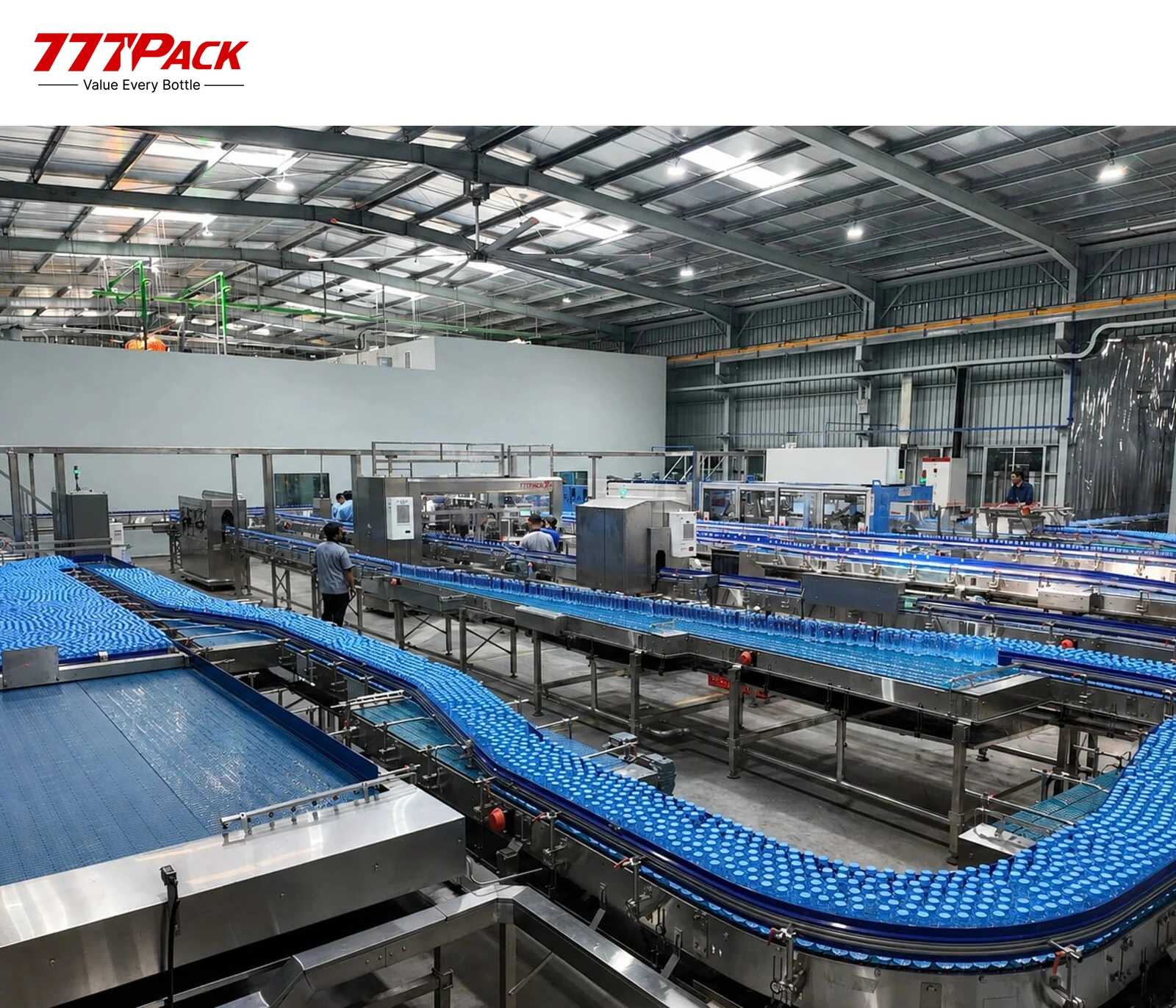
Reference conveyor installation. The route, transfer points and accumulation sections follow the approved line layout.
Pressureless Bottle Conveyor Systems
Connect beverage-line machines with segmented speed control and low-friction accumulation. The system manages bottle flow and limits the build-up of pressure between bottles, helping protect bottles and labels during transfer and buffering.
Line integration
Position in the Production Line
The highlighted rail shows how this conveyor system connects process machines. It is a transfer system across several sections of the line.
Water Treatment and Bottle Blowing take place earlier; Palletizing follows packing.
Swipe or scroll to explore the connected stages →
Filled-bottle transfer & buffering from filler outfeed to packaging infeed. Final covered sections are defined for each project. This example does not mean every connection requires the same conveyor configuration. Process machines are shown for context.
System Overview
The conveyor system links individual machines into a coordinated production line. Its task is to deliver bottles at the required rate while managing the temporary differences between upstream and downstream equipment.
This pressureless bottle conveyor concept combines sectional speed control with low-friction accumulation. Coordinating the conveying sections helps limit bottle-to-bottle backpressure and reduce rubbing, collision and tipping risks. Handling performance depends on the bottle format, filled weight, surface condition, settings and route.
Design the Connections Alongside the Machines
Conveyor planning starts with the actual machine positions and bottle flow. Define where bottles enter and leave each machine, where short-term accumulation is needed, and which access routes must remain clear. Confirm the conveyor route, transfer heights and operating sequence together.
For full-line planning, explore our bottled water production lines, juice production lines and carbonated beverage lines. The pre-sale engineering review can match conveyor sections to the selected filling, labeling and packaging equipment.
How Pressureless Bottle Conveying Works
Conveying and buffering are coordinated with the connected machines.
Handling Benefits
Design objectives for stable bottle flow and practical line operation.
Controlled accumulation
Limit bottle backpressureSectional speed control and low-friction accumulation help manage the pressure that can build up when bottle flow slows.
Bottle and label care
Reduce rubbing and instabilitySmoother transfers and appropriate guide/contact conditions help reduce scuffing, collisions and tipping risks. Confirm results using representative bottles.
A layout matched to the line
Route · Transfers · AccessThe route and transfer arrangement are configured around the machine positions, bottle formats and available factory space.
Configuration & Selection Data
The final specification follows your bottle range, machine interfaces and factory layout.
| System function | Bottle transfer and low-pressure accumulation between selected beverage-line machines |
|---|---|
| Control principle | Segmented speed control coordinated with line operation |
| Accumulation concept | Low-friction buffering; usable capacity defined for the bottle and layout |
| Bottle formats | Confirm material, dimensions, shape, filled weight, rigidity and label surface |
| Required throughput | Specify normal and peak containers/hour for the complete line |
| Buffer requirement | Specify the intended interruption duration and operating conditions |
| Conveyor route | Approved lengths, curves, elevations, transfer points and access routes |
| Machine interfaces | Discharge/infeed geometry, pitch requirements, speed coordination and signals |
| Controls and sensing | Agree section arrangement, sensing points, start/stop logic and fault response |
| Materials and cleaning | Confirm contact surfaces, chain/belt arrangement, environment and cleaning method |
| Power and installation | Electrical supply, connected load, supports and service space follow the final design |
| Acceptance basis | Approved bottles, output, accumulation conditions, restart sequence and inspection criteria |
Line Integration
Pressureless bottle conveying connects process machines at multiple positions. The example above shows filled PET bottles from filler outfeed to packing-machine infeed. The red rail identifies the conveying system; the process machines provide context.
Empty-bottle air conveying and conveying of finished packs or pallets are separate handling tasks. Include them explicitly if they are required in the complete project.
- Filling-machine outfeed: Match bottle discharge stability, conveyor elevation and upstream run/stop behaviour. See the PET bottle water filling machine.
- Drying and coding: Confirm transfer geometry, surface condition and the infeed requirements of the coding and marking equipment.
- Labeling: Agree infeed pitch, flow stability and label/contact-surface compatibility with the labeling machine.
- Packing-machine infeed: Confirm bottle arrangement and the packer’s acceptance rate. Coordinate the buffer with the selected secondary packaging equipment.
- Line control: Document the required status signals, section-speed coordination, restart sequence and agreed response to a full buffer. Confirm the included conveying sections in the project scope.
Bottle & Label Compatibility
Provide representative bottles and drawings before confirming the conveyor design. PET and glass bottle applications are reviewed against the selected format and handling conditions.
- Geometry and stability: confirm the base, diameter or cross-section, height and centre-of-gravity behaviour with the intended fill level.
- Weight and rigidity: review filled mass and bottle stiffness when defining guides, transfers, speeds and accumulation conditions.
- Label and surface: include label material, decoration, contact-sensitive areas and any wet or warm surface conditions.
- Format changes: agree guide settings, change parts or stored settings where specified. Confirm what adjustment is needed for each approved format.
The final bottle range and operating conditions form part of the technical agreement and acceptance test.
Cleaning & Maintenance Planning
Accessible inspection
Check contact and transfer pointsPlan access to the selected chain/belt, guides, wear strips, supports and transfer points. Inspect wear and bottle-contact conditions during routine maintenance.
Cleaning matched to the design
Agree the method and frequencySelect cleaning procedures for the actual materials, environment and manufacturer instructions. Confirm whether wet cleaning is appropriate for the supplied configuration.
Settings and wear management
Keep the approved conditionsDocument section speeds, guide settings and restart behaviour for each format. Review changes when a new bottle, label or production condition is introduced.
General background: EHEDG GL 43 — Hygienic Design of Belt Conveyors for the Food Industry. Select cleaning and hygiene provisions for the actual operating environment.
Testing & Acceptance
Agree the bottle formats, conditions and inspection criteria before commissioning.
Bottle and label checks
Representative production samplesRun the approved bottle and label formats through the planned transfers. Inspect stability, guide contact, rubbing and label appearance.
Output and accumulation
Agreed running conditionsCheck sustained line output and the usable buffer under the agreed machine-rate and interruption conditions.
Stops and restart
Controlled line scenariosCheck downstream blockage, upstream gaps and restart sequence with the selected control logic. Confirm what happens when the buffer reaches its limit.
Layout and handover
Final configuration recordCheck elevations, access routes, guides, supports and machine interfaces. Record the agreed settings and hand over the maintenance and operating information.
Frequently Asked Questions
Handling principle, sizing, compatibility and integration.
What does pressureless bottle conveying mean?
It describes a conveying and accumulation approach intended to limit the backpressure between bottles. Segmented speed control and low-friction handling help manage bottle flow as it moves between machines. The approved bottle, layout and settings determine the actual operating behaviour.
Does pressureless mean unpowered or friction-free?
The conveying sections are driven and speed-managed. Mechanical contact still moves the bottles. Pressureless refers to limiting accumulation pressure; it does not mean zero friction or an unpowered gravity conveyor.
Does it guarantee zero scratches, tipping or line stops?
The design aims to reduce these risks. Bottle geometry, rigidity, labels, contact surfaces, transfers, settings and maintenance all affect results. Confirm the required handling performance using representative bottles and agreed test conditions.
How much buffer capacity do I need?
Start with the normal/peak line rate and the short interruption you want to accommodate. Then review the actual bottle size, layout and operating pattern. Usable accumulation capacity is confirmed for the selected arrangement; a stopped downstream machine cannot be buffered indefinitely.
Which bottle sizes and production speeds are available?
The bottle range and throughput are specified for the project. Send bottle drawings/samples, filled weight, label details and normal/peak containers per hour. No single fixed format range or output applies to every conveyor layout.
Is this the same as an empty-bottle air conveyor?
No. This page covers mechanically driven bottle conveying and accumulation between line machines. Empty-PET-bottle air conveying is a different system, typically using directed air and neck-ring support. Define that scope separately if needed.
Can it connect to existing machines?
Existing-line integration can be reviewed using the actual machine discharge/infeed details, available space and control interfaces. Provide elevations, transfer geometry, operating speeds and layout drawings. Our pre-sale review can identify the required interfaces.
Can PET and glass bottles use the same settings?
Do not assume one setting suits every format. Confirm the material, filled weight, bottle shape, stability and label/contact conditions. Agree the approved range and the adjustments required during changeover.
What cleaning, material and control features are included?
These are defined in the final specification. Confirm the contact surfaces, chain/belt system, lubrication requirements if applicable, cleaning method, section controls, sensing and machine signals. Component brands and electrical ratings follow the agreed configuration.
What should I send for a quotation?
Provide the factory layout, machine positions and connection heights, bottle drawings/samples, fill weights, label types, target output, intended buffering requirement and available utilities. Identify the machines and conveyor sections to include. Request a conveyor layout review.
Project Services
Manufacturing & Line Integration
Core equipment manufacturing, auxiliary-machine coordination and complete-line integration are managed as one system to reduce interface risks before delivery.
FAT & Quality Inspection
Project checks before packing and delivery.
Installation & Commissioning
On-site setup, testing and operator training.
Local Support in Indonesia
Local coordination for service and spare parts.
Connect Your Machines with a Matched Conveyor Layout
Send your bottle range, line rate and factory plan so the transfer routes, accumulation areas and machine interfaces can be reviewed together.