STILL WATER · PET BOTTLES
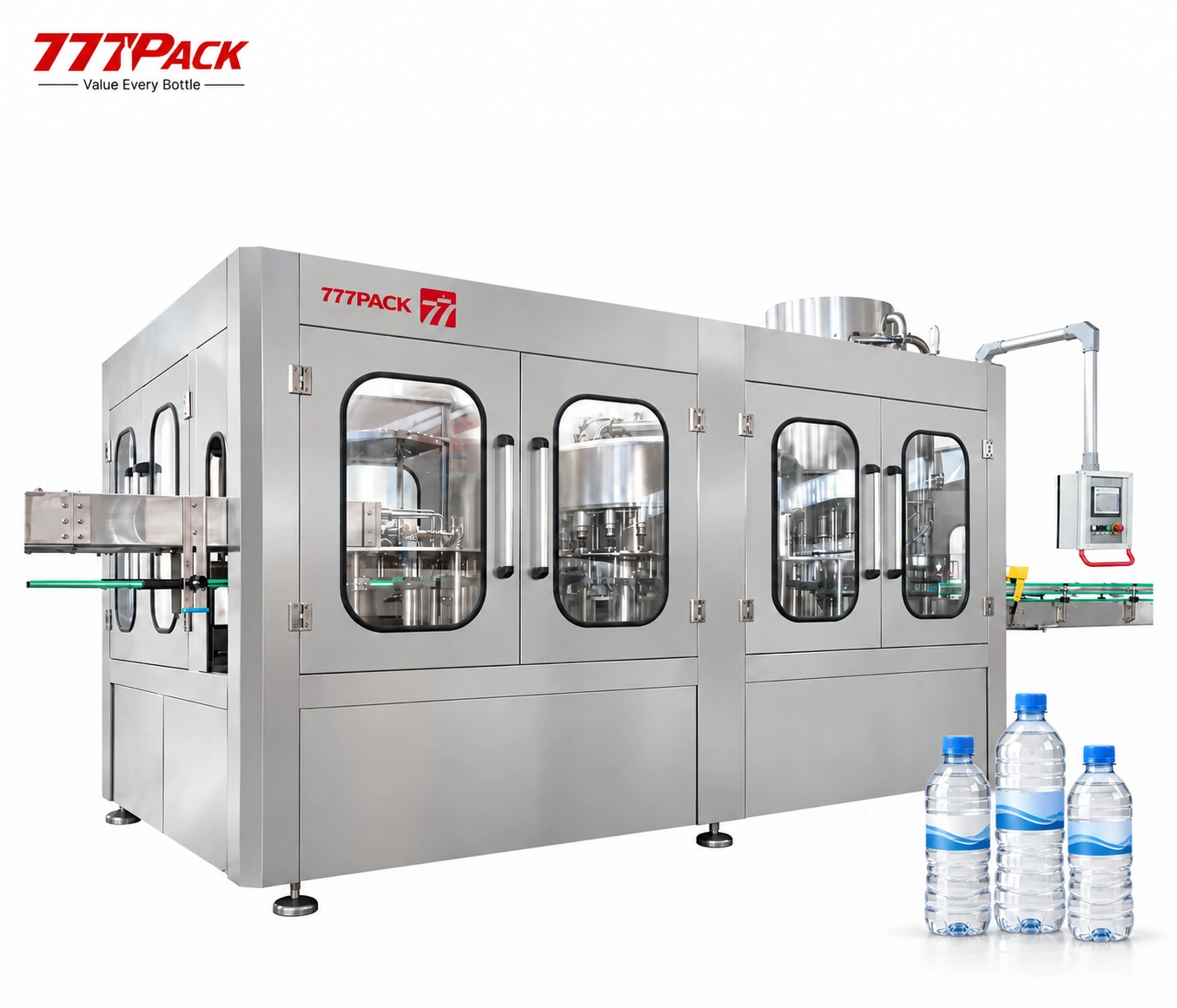
PET Bottle Water
Filling Machine
Rinse, fill and cap in one rotary machine.
† 500 mL round PET reference; other formats need review.
* Bottle and cap approval required.
YOUR MACHINE IN CONTEXT
Position in the Production Line
Water treatment and empty-bottle supply feed the filling stage. Drying, coding, labeling and packing continue downstream.
- Parallel preparation01AWater TreatmentFilter · Purify · Disinfect01BBottle BlowingPreform to Bottle
- 02FillingRinse · Fill · CapCURRENT
- 03DryingRemove Surface Moisture
- 04CodingDate · Batch · Traceability
- 05LabelingSleeve · Hot Melt · Self-Adhesive
- 06PackingFilm · Carton · Tray
- 07PalletizingStack Finished Packs
Reference flow only. Final process and equipment scope depend on the product, container, output and project requirements. Each stage links to its equipment or equipment category.
The highlighted filling stage combines rinsing, filling and capping. The surrounding equipment is specified separately in your project scope.
PLAN YOUR MACHINE
Your Main Questions
Is This Filler Right for Your Water Project?
Start with your water, packaging and production goal. This independent 3-in-1 machine receives empty PET bottles, rinses them, fills still water and applies plastic screw caps.
Expanding a water brand
Review the filling stage alongside your bottle supply and packing equipment. Establish which stage restricts your current output before choosing a larger filler.
Replacing an existing filler
Check whether your bottle formats, conveyors, utilities and controls can connect to the proposed machine. Define retained equipment and modification work together.
Building a new PET water line
Plan treated-water supply, empty-bottle supply and downstream packaging around filling. The monoblock is one stage of the factory, so supporting equipment needs its own scope.
Purified, mineral, spring and other non-carbonated water applications are the starting scope. Carbonated drinks, juice, hot filling or aseptic requirements need a separate process assessment. The PET volume range of 200–2,000 mL is an initial screening reference; each bottle and closure combination still requires approval.
Check My Product and PackagingHow the Three Operations Work Together
Follow the bottle through the machine, and see which project conditions each stage needs.

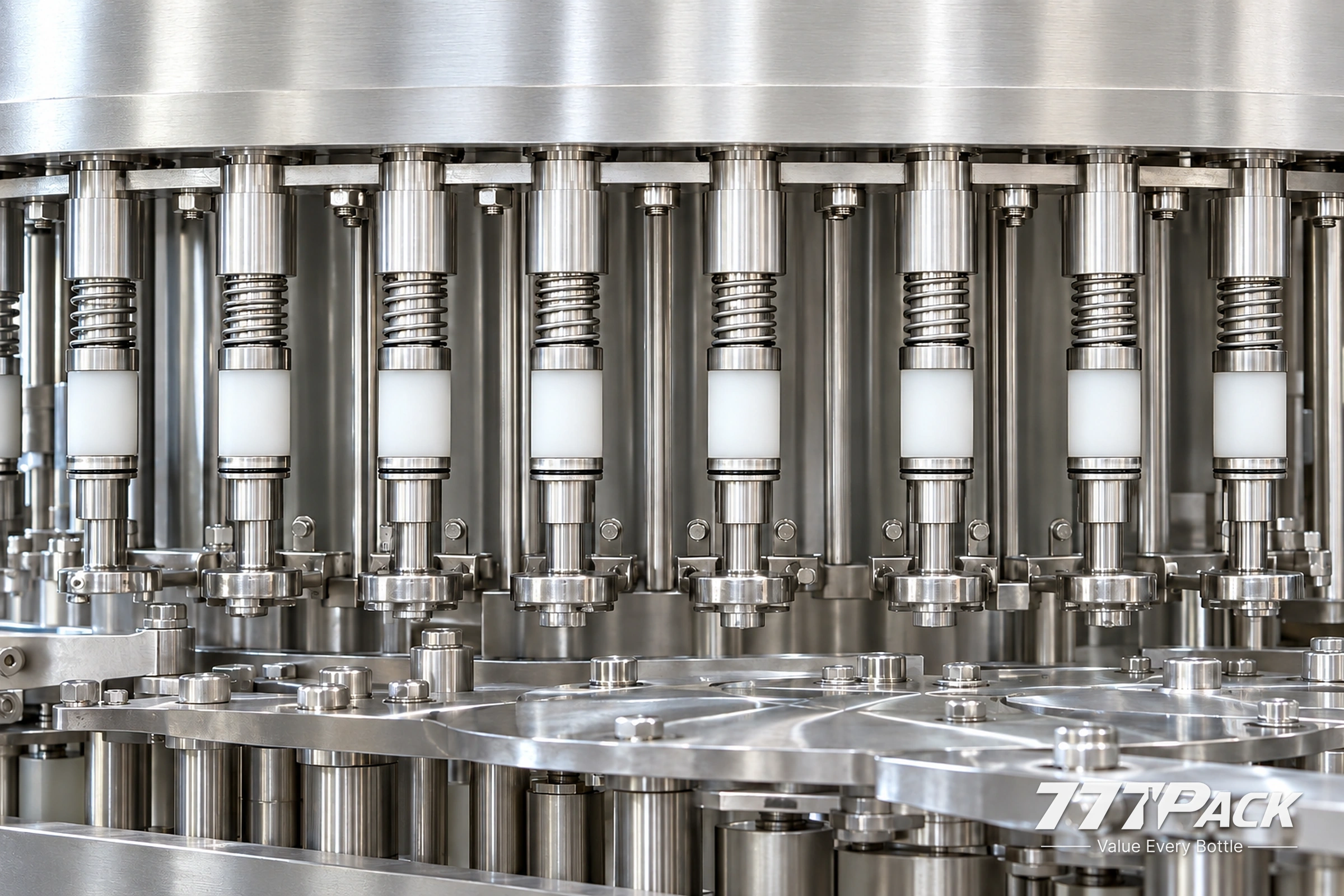
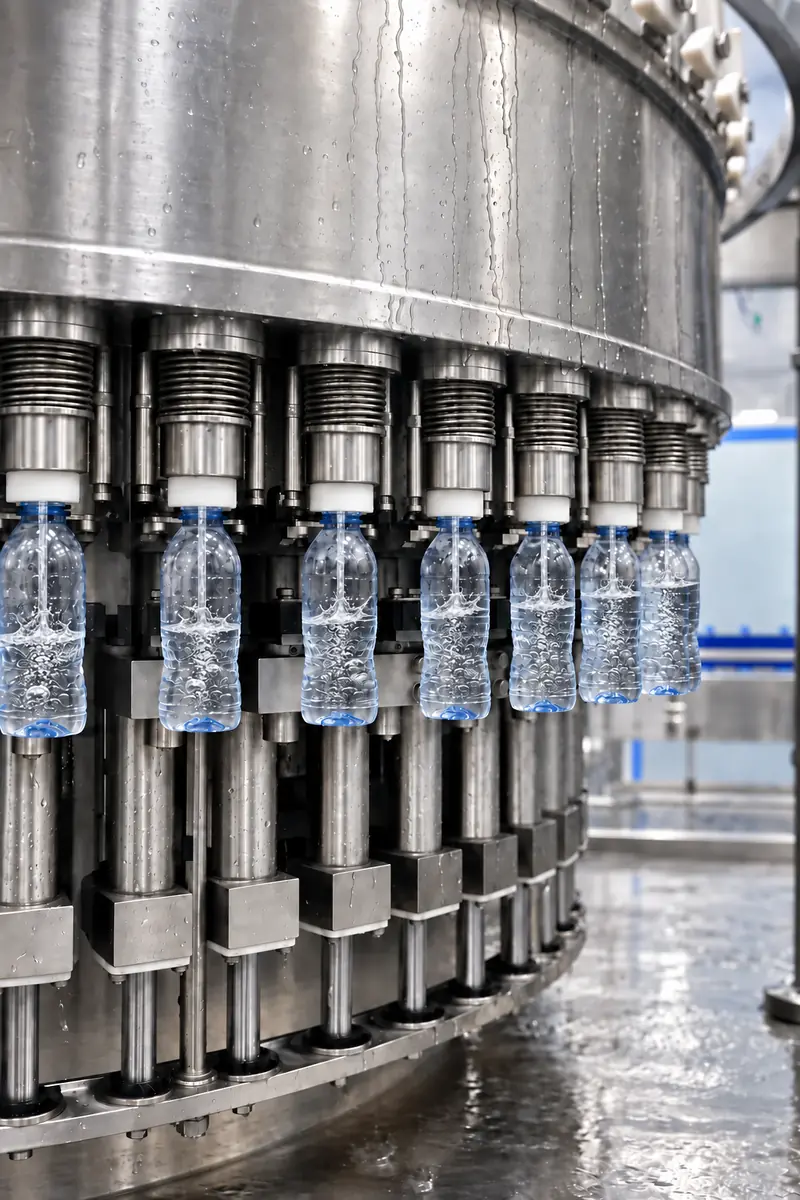
Rinse the empty bottle
Neck-handling transfer moves the bottle into inversion and internal rinsing with treated water. Agree the rinse-water supply, drainage and bottle handling. Rinsing alone does not establish sterilization.

Fill with still water
The filling section uses atmospheric gravity filling. Bottle geometry, required fill setting and stable product supply belong in the output review. No-bottle/no-fill protection is part of the published configuration.

Transfer and apply the cap
Approved bottle and cap samples guide handling and closure configuration. Check transfer, cap application and sealing as a matched packaging system before accepting the machine.
The images show existing product-page assemblies. They explain the mechanism and do not represent a documented performance test with your packaging.
Will Your Bottle and Cap Work Together?
A bottle's volume is only the starting point. Its dimensions, neck finish, support features and closure must also suit transfer, rinsing, filling and capping.

In this XGF arrangement, bottles are transferred by the neck between stages. Neck and support geometry therefore matter to compatibility. Body clearances and the closure system need their own checks. The neck finish describes the geometry at the bottle opening that must match the intended cap.
| What changes between your SKUs? | What should be checked? |
|---|---|
| Volume or body shape; same neck and cap | Handling, clearances, fill settings and any required format parts. |
| Neck finish or support geometry | Bottle transfer, support, filling interface and relevant format parts. |
| Closure design or specification | Cap supply and application, sealing and tamper-evidence checks. |
Prepare a packaging set
- A drawing for each important bottle.
- Neck-finish details and matching cap specifications.
- Bottle and cap samples, where available.
- Target output and expected changeover frequency.
Ask for an approved-format schedule
The proposal should identify the combinations covered, parts supplied for the first format and items required for additional formats. Keep samples identified so that transfer and sealing are assessed with the correct pair.
Changeover may involve adjustments, components and a restart check. A useful time claim identifies the starting and finishing formats, the work included and the trial conditions. Avoid treating one changeover demonstration as a time guarantee for every bottle and cap.
Review My Bottle and Cap FormatsWhat Output Should You Plan For?
Plan around the bottle you intend to sell and the saleable output your factory needs. The published 8,000–40,000 BPH range uses a 500 mL round PET bottle reference.

A different format needs its own output review. Changing bottle volume does not provide a reliable proportional speed conversion: filling duty, transfer, cap application and line conditions also matter. List required output for each major SKU, together with its bottle, cap and operating schedule.
A planning example with stated assumptions
Suppose the target is 80,000 acceptable 600 mL bottles over eight scheduled hours. With a provisional combined factor of 0.80 for stops, speed losses and rejects, the discussion target is:
80,000 ÷ (8 × 0.80) = 12,500 bottles per hour under the 600 mL conditions.
This is an illustrative calculation, not a machine rating or model recommendation. Replace the factor with your own assumptions. Do not deduct the same losses again or choose from the 500 mL rating alone.
For each important format, ask the proposal to connect an output statement with the approved packaging, supporting conditions and acceptance method. This creates a checkable performance basis rather than a number detached from your project.
Compare All Eight Published XGF Configurations
Rated outputs below refer to 500 mL round PET bottles. These published references support initial comparison. Your format-specific output and configuration are confirmed separately.
| Model | Rinsing heads | Filling heads | Capping heads | Reference BPH · 500 mL |
|---|---|---|---|---|
| XGF16-16-5 | 16 | 16 | 5 | 8,000 |
| XGF24-24-8 | 24 | 24 | 8 | 12,000 |
| XGF32-32-10 | 32 | 32 | 10 | 16,000 |
| XGF40-40-15 | 40 | 40 | 15 | 18,000 |
| XGF50-50-15 | 50 | 50 | 15 | 24,000 |
| XGF60-60-15 | 60 | 60 | 15 | 30,000 |
| XGF72-72-18 | 72 | 72 | 18 | 36,000 |
| XGF80-80-24 | 80 | 80 | 24 | 40,000 |
Shared published range: PET 200–2,000 mL with approved plastic screw caps; atmospheric gravity filling. Bottle range does not approve every bottle geometry or closure.
Technical Configuration References
| Item | Published reference or project check |
|---|---|
| Process | Rotary rinsing, atmospheric gravity filling and screw capping. |
| Structure and product contact | SUS304 structure; SUS316L product-contact material. |
| Controls and components | Siemens PLC/HMI, Danfoss VFD and Festo pneumatics in the published configuration. |
| Installed power | Published series range 2.2–15 kW; confirm the selected model and equipment boundary. |
| Machine dimensions (L × W × H) | Published series range 2,760 × 2,060 × 2,250 to 7,800 × 6,380 × 2,300 mm. Confirm the dimensions and service clearance for your selected model. |
| Utilities and installation | Confirm model-specific electrical supply, compressed air, water supply, drainage, dimensions and service space. |
| Safety functions | Published functions include no-bottle/no-fill protection, alarms and safety interlocks. Confirm the selected configuration. |
| Cleaning connection | CIP interface and dummy bottles are project-confirmed options. |
Component names identify the proposed configuration; they do not establish a guaranteed production result. Use the agreed specification and test plan to verify the complete arrangement.
Can You Keep Your Existing Blower?
An independent filler is worth evaluating when useful bottle-making or downstream equipment can remain in service. First identify the current bottleneck and the work needed to connect the line.
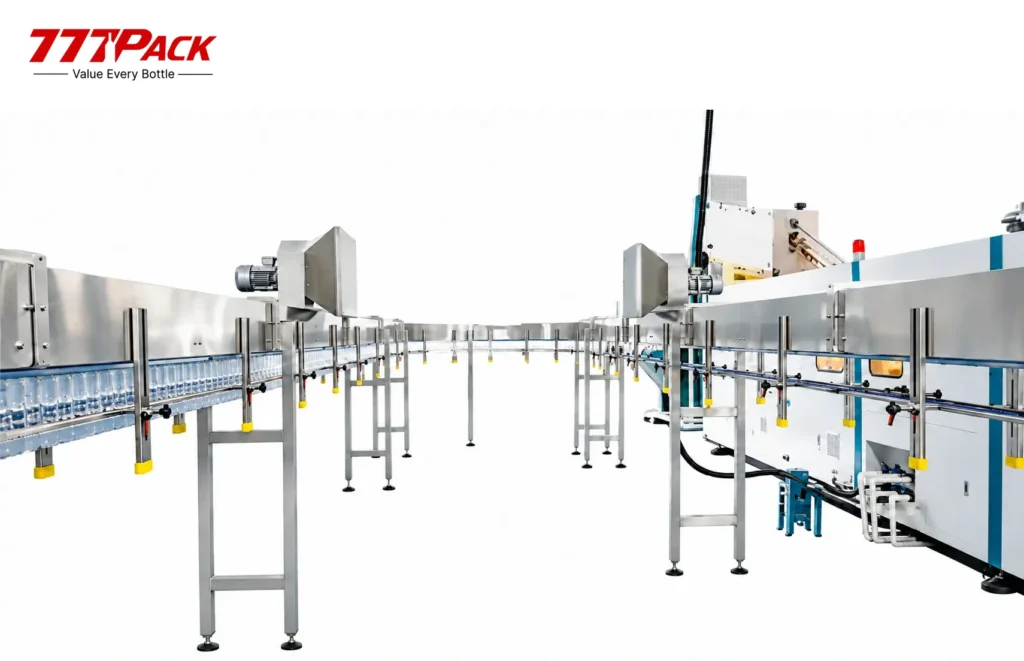
Record actual bottle supply, transfer route, labeling and packing performance using the intended format. Review conveyor arrangement, utilities, space and control signals. A faster filler cannot deliver its full output if bottles arrive too slowly or the next stage cannot receive them.
See a Bottle-Line Bottleneck Example
Assume a 600 mL line has verified capacities of 12,000 bottles/hour for blowing, 15,000 for the proposed filler and 10,000 for labeling. Packing at eight packs/minute with 24 bottles per pack is equivalent to 11,520 bottles/hour.
Labeling limits this simplified example to a theoretical 10,000 bottles/hour before further operating losses. Replacing the filler alone does not create a 15,000-bottle/hour line. All numbers are teaching assumptions, not 777Pack model or customer performance.
Compare an independent filler with a Combi-block
| Decision area | Independent filler review | Integrated blow-fill-cap review |
|---|---|---|
| Existing assets | Identify which bottle-supply equipment can remain and what modification is required. | Assess the equipment replaced by the integrated arrangement and any remaining assets. |
| Transfer and layout | Define empty-bottle transfer, accumulation and interfaces. | Review the integrated transfer arrangement, full equipment boundary and access. |
| Output and formats | Match filling to the retained supply and downstream equipment. | Match the coordinated blowing, filling and capping configuration to the same formats. |
| Operation and maintenance | Review how individual stages, changeover and interruptions are managed. | Review coordinated operation, changeover and maintenance requirements. |
| Total project scope | Include interfaces, retained-equipment work, auxiliaries and services. | Include the complete integrated equipment, auxiliaries, interfaces and services. |
Use equivalent bottle formats, targets and supply boundaries in the comparison. Claimed space, water or electricity differences need comparable layouts or operating data. Integration alone does not establish a fixed saving.
Review My Existing LineWhat Else Does Your Factory Need?
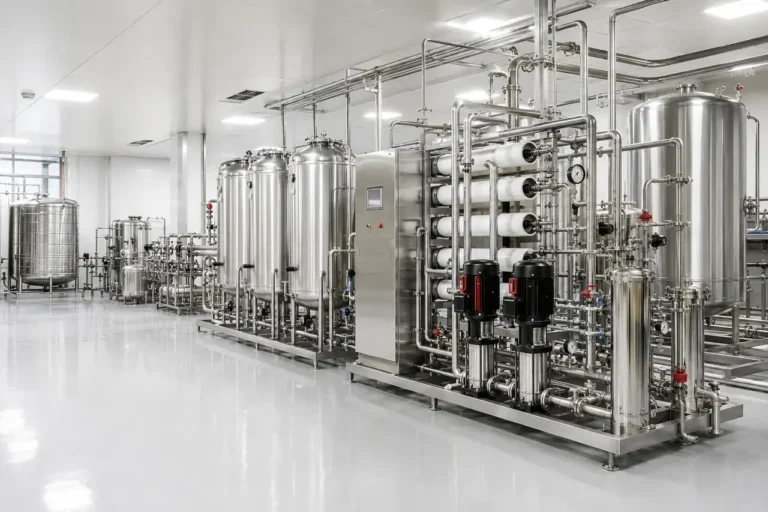
Make quotations comparable by defining the machine, supporting equipment and factory responsibilities together.
| Scope item | What to agree |
|---|---|
| Machine and packaging formats | Selected model, approved bottles and caps, initial format parts and additional SKU requirements. |
| Bottle supply and downstream equipment | Retained, modified and newly supplied machines; conveyors and control interfaces. |
| Factory utilities | Electrical supply, water connections, compressed air, drainage and any external supporting equipment. |
| Cleaning arrangement | Connection points, dummy bottles, supporting equipment, operating instructions and responsibility. |
| Testing and services | Acceptance scope, installation, commissioning, training, documentation and spare parts. |
Use a model-specific utility schedule and a complete installation layout. Distinguish main-machine installed power from operating consumption and from the power required by external equipment. A machine footprint also needs space for access, format changes and maintenance.
Water treatment, bottle rinsing and machine cleaning have different tasks
Water treatment prepares the product supplied to filling. Empty-bottle rinsing addresses the bottle before filling. Equipment cleaning addresses the machine and its product-contact circuits. These descriptions alone do not establish sterilization or an aseptic process.
CIP connections and dummy bottles belong to an agreed project configuration. Confirm the complete cleaning scope in the quotation, including any return path and external equipment. A connection option should not be read as a complete CIP system included with every machine.
Check My Site and Supply ScopeHow Will Your Configuration Be Checked and Supported?
Agree how the proposed machine will be verified, delivered and handed over before judging the order by price alone.
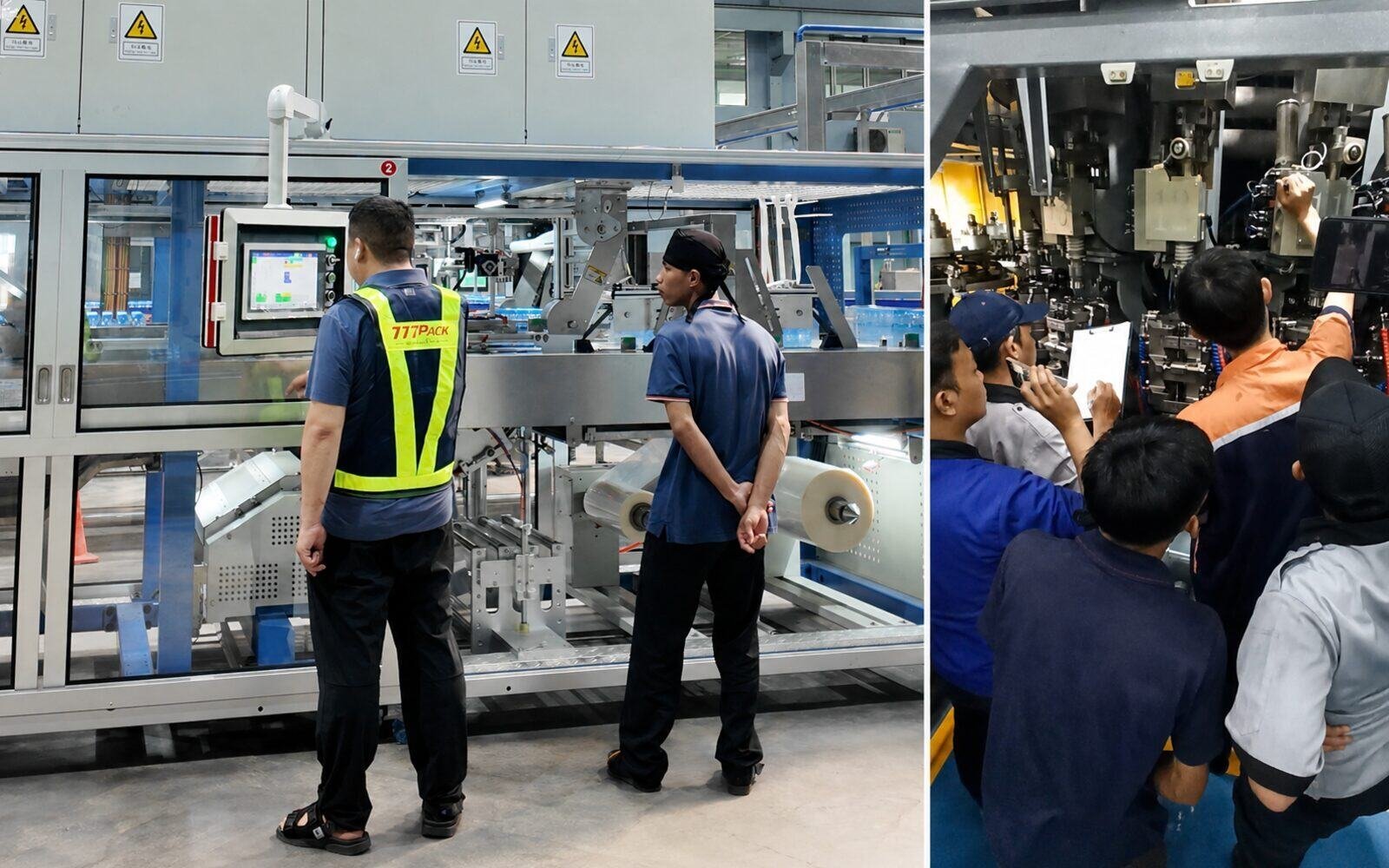
Define the acceptance trial
- Identify the bottle and cap samples.
- State the output basis and operating conditions.
- Agree run duration, measurements and pass criteria.
- Include relevant transfer, fill and closure checks.
- Record interruptions, deviations and corrective actions.
Make the checks specific
A factory acceptance test, or FAT, should relate to the selected configuration. Agree which alarms, interlocks, format changes and supplied interfaces are included. Filling and closure results need an agreed measurement method and acceptance limits.
Set delivery milestones and responsibilities
Confirm the sequence for packaging approval, configuration agreement, manufacturing, testing, shipment and site work. Identify what must be supplied or approved before each milestone. Design changes, sample availability and factory readiness should be addressed in the project schedule.
Prepare for routine operation
The handover should identify operating instructions, training, maintenance information and applicable spare parts. Use the selected machine's instructions for inspection and safe adjustment. Keep bottle formats and parts identified for repeatable changes.
Confirm support for your Indonesia location
Ask the proposal to define technical contacts, diagnostic information, escalation, spare-parts arrangements and any agreed site attendance. Confirm the actual responsibility and terms for your location; response and recovery times depend on those arrangements.
A Complete-Line Reference from Bandung
Explore the 33,000 BPH · 250 mL PET bottled water project for its factory process, downstream equipment and integration scope.
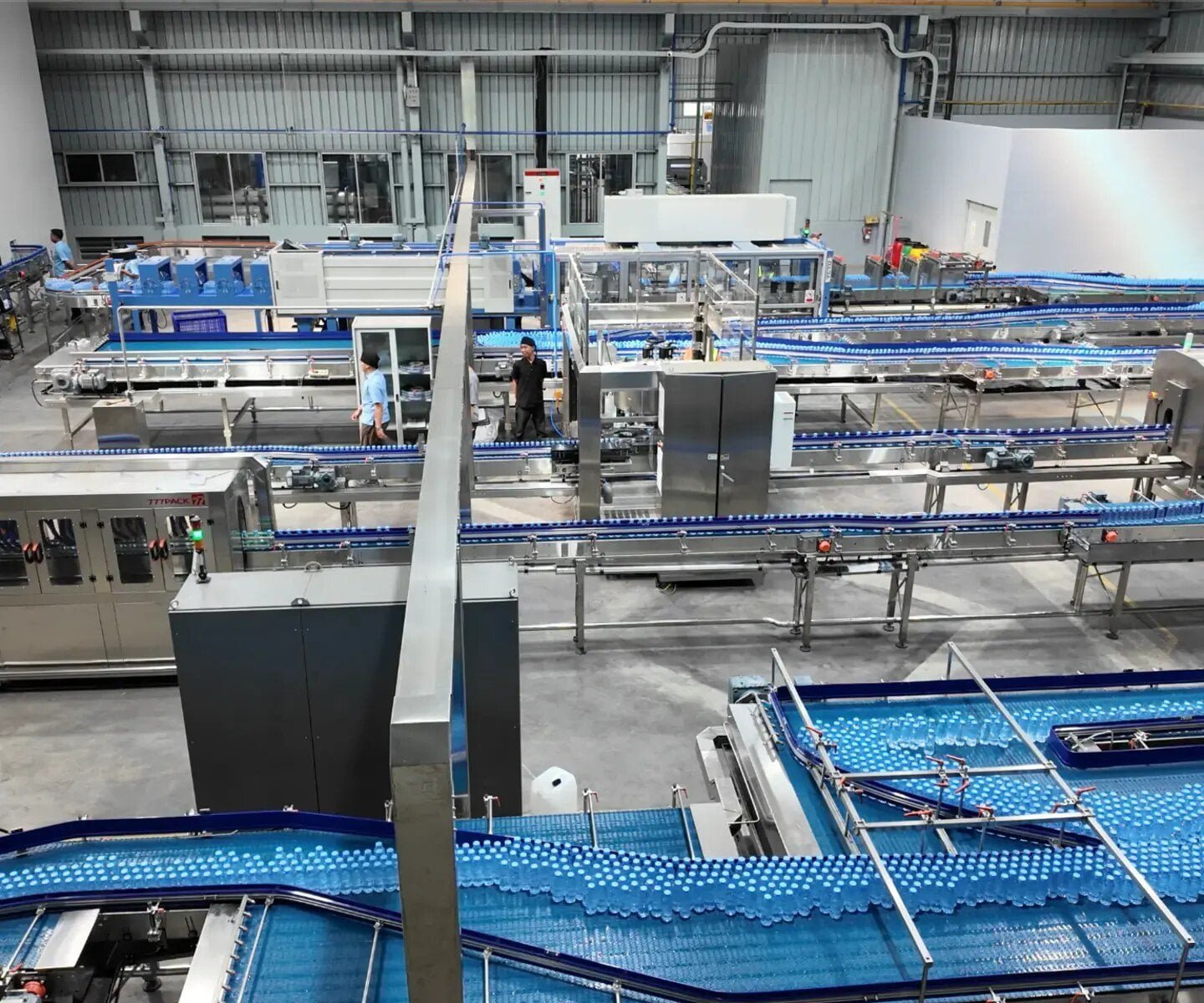
This delivered project uses a Combi-block configuration. It is a reference for complete-line planning and does not demonstrate the performance of this independent XGF filler. For your order, request evidence that matches the proposed machine, packaging and operating conditions.
View the Bandung Combi-block ProjectQuestions Before You Choose
Short answers, with the selection details available above.
What products can this PET water filler handle?
Its starting scope is purified, mineral, spring and other non-carbonated water in approved PET bottles. Carbonated, juice, hot-fill or aseptic requirements need a separate process and configuration assessment. Review suitability.
Is the stated speed available with my 600 mL bottle?
The published ratings use a 500 mL round PET bottle. Confirm output for the actual bottle, cap, supply and line conditions rather than converting by volume alone. Read the capacity guide.
Can one machine handle several bottle sizes?
The published 200–2,000 mL range is an initial reference. Each format needs approval, and changes may involve adjustments or additional parts. Check bottle, cap and changeover requirements.
Can it connect to my existing line?
Review actual format-specific capacities, bottle transfer, conveyor arrangement, utilities and control interfaces before defining the connection work. Review existing-line integration.
What should be checked before shipment?
Agree samples, operating conditions, trial scope, measurements and acceptance criteria. Record results and any corrective work against that plan. Review acceptance and handover.
Learn the Terms Used in Your Configuration Review
Reference output and saleable output
A published reference belongs to its stated test conditions. Saleable output describes acceptable finished production over a defined period. Specify the time basis and losses when comparing them.
Neck finish and closure
The bottle opening and its cap form a matched system. A shared nominal opening size does not by itself approve every neck, cap or machine arrangement.
Format parts and changeover
Different bottles or caps can require adjustments and dedicated components. Define both the packaging pairs and the changeover work covered by a proposal.
FAT and the acceptance record
The factory test plan sets the checks and conditions. The results record shows what was tested, what happened and which deviations were resolved or remain outstanding.
LET'S START WITH YOUR BOTTLE
Check Your Bottle, Capacity
and Line Requirements
Tell us what you need to produce. Start with the bottle and cap, target output and whether the filler will join an existing line.
Useful information for the review
- Bottle drawings and neck-finish details.
- Matching cap specifications and samples.
- Required output for each important SKU.
- Equipment list and factory layout.
- Project location and planned operating schedule.
These inputs help define the model review, format requirements, utility checks and connection scope.
Request a configuration review
Share your bottle and cap details, production target and line layout so we can review your project.
Request a Quote