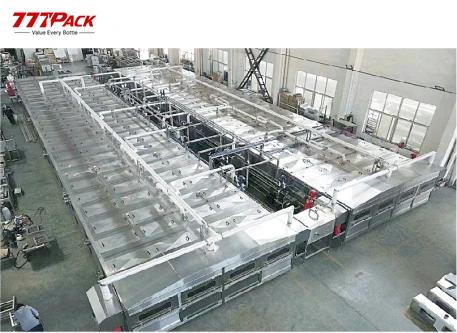
Similar exterior appearance. This reference image illustrates the general tunnel form. The internal system differs for each product.
Beverage Spray Tunnels
Tunnel pasteurizers, bottle cooling tunnels and bottle warming tunnels are three separate machines. Their exterior can look similar. Each product has its own internal thermal system and a different job after filling.
Three products · Three line examples
Position in the Production Line
Choose a product to see its role in an example production line. These are three separate products with different internal process designs.
This example shows a glass-bottle beer line using a dedicated tunnel pasteurizer after filling and sealing. Pasteurization is the current stage.
Swipe or scroll to explore all stages →
Example for a validated glass-bottle beer pasteurization process. Confirm the actual product, package and thermal schedule for the project. Each stage links to related equipment or its equipment category.
This example shows a PET juice and tea hot-fill line using a dedicated bottle cooling tunnel after filling and bottle inversion. Cooling is the current stage.
- 01Water TreatmentFilter · Purify · Disinfect
- Parallel preparation02AProduct PrepMix · Blend · Heat02BBottle BlowingPreform to Bottle
- 03FillingRinse · Fill · Cap
- 04Bottle InversionSterilize Cap & Neck
- 05CoolingCool Hot-Filled ContainersCURRENT
- 06DryingRemove Surface Moisture
- 07CodingDate · Batch · Traceability
- 08LabelingSleeve · Hot Melt · Self-Adhesive
- 09PackingFilm · Carton · Tray
- 10PalletizingStack Finished Packs
Swipe or scroll to explore all stages →
Example for a PET hot-fill juice or tea process. Confirm the hot-fill conditions, bottle and closure suitability, cooling profile and discharge temperature. Each stage links to related equipment or its equipment category.
This example shows a cold-filled carbonated beverage line using a dedicated warming tunnel. The example package is a metal can; bottle applications require a separately matched package and process configuration.
- 01Water TreatmentFilter · Purify · Disinfect
- Parallel preparation02AProduct PrepMix · Chill · Carbonate02BDepalletizingUnload · Separate · Feed
- 03RinsingRinse · Drain · Prepare
- 04FillingFill · Seam
- 05WarmingWarm · Reduce CondensationCURRENT
- 06DryingRemove Surface Moisture
- 07CodingDate · Batch · Traceability
- 08LabelingSleeve · Hot Melt · Self-AdhesiveOptional
- 09PackingFilm · Carton · Tray
- 10PalletizingStack Finished Packs
Swipe or scroll to explore all stages →
Example for a cold-filled carbonated beverage in metal cans. Confirm the actual bottle or can, fill temperature, ambient conditions and warming target for the selected tunnel. Surface drying remains a separate downstream stage. Each stage links to related equipment or its equipment category.
Each flow is a product-specific example. The three tunnels have separate treatment purposes and are selected individually. Final equipment scope depends on the product, package and approved process.
Three Products at a Glance
Similar outside. Different internal systems, processing objectives and selection criteria.
Tunnel Pasteurizer
Apply a defined pasteurization treatment
- Internal function
- Heating zones, the required treatment exposure and cooling zones are arranged to achieve the approved product temperature–time profile.
- Typical application
- Beverages with an approved post-fill pasteurization process
Bottle Cooling Tunnel
Reduce temperature after hot filling
- Internal function
- Progressive cooling zones and the spray-water cooling circuit are designed to remove heat at the required rate.
- Typical application
- Hot-filled beverages, such as a suitable juice product
Bottle Warming Tunnel
Warm cold-filled containers to reduce condensation
- Internal function
- Staged warming zones and the heating circuit raise container temperature towards the discharge target selected for local conditions.
- Typical application
- Cold-filled carbonated beverages before downstream handling
| Compare | Tunnel Pasteurizer | Bottle Cooling Tunnel | Bottle Warming Tunnel |
|---|---|---|---|
| Main purpose | Apply a defined pasteurization treatment | Reduce temperature after hot filling | Warm cold-filled containers to reduce condensation |
| Thermal progression | Heat → Hold → Cool | Hot-filled → Gradually cooled | Cold-filled → Gradually warmed |
| Typical infeed | Filled, sealed containers; inlet condition follows the approved process. | Hot-filled, closed containers; approximately 85°C is one example inlet condition. | Cold-filled, closed containers; approximately 0–4°C is one example inlet condition. |
| Discharge objective | The specified heat treatment has been applied and the containers reach the agreed discharge condition. | Containers reach the lower temperature specified for downstream handling. | Warmer containers with a reduced tendency to develop external condensation. |
| Basis for selection | Approved pasteurization profile and target output | Required heat removal and discharge temperature | Required warming and local condensation conditions |
01 — Tunnel Pasteurizer
The tunnel pasteurizer is the product to select when the beverage process calls for a defined heat treatment after filling and closing. The internal thermal arrangement provides the required heating progression, treatment exposure and controlled cooling.
What happens inside?
Heating zones, the required treatment exposure and cooling zones are arranged to achieve the approved product temperature–time profile.
Infeed and discharge
Infeed: Filled, sealed containers; inlet condition follows the approved process. Discharge: The specified heat treatment has been applied and the containers reach the agreed discharge condition.
What to confirm
Confirm the formulation, package, inlet temperature, approved temperature–time target, production rate and method of thermal-profile verification. Pasteurization targets and storage conditions must be established for the actual product.
02 — Bottle Cooling Tunnel
The bottle cooling tunnel is a separate product for reducing the temperature of hot-filled containers. Its internal system is designed around heat removal and a controlled cooling progression that suits the beverage and package.
What happens inside?
Progressive cooling zones and the spray-water cooling circuit are designed to remove heat at the required rate.
Infeed and discharge
Infeed: Hot-filled, closed containers; approximately 85°C is one example inlet condition. Discharge: Containers reach the lower temperature specified for downstream handling.
What to confirm
Confirm filling temperature, fill volume, the required discharge temperature, bottle/closure thermal limits, available cooling-water conditions and target output. The cooler’s purpose is temperature reduction after the upstream filling process.
03 — Bottle Warming Tunnel
The bottle warming tunnel is a separate product for raising the temperature of cold-filled containers. Its internal warming system is selected around the inlet condition, local temperature and humidity, package requirements and target output.
What happens inside?
Staged warming zones and the heating circuit raise container temperature towards the discharge target selected for local conditions.
Infeed and discharge
Infeed: Cold-filled, closed containers; approximately 0–4°C is one example inlet condition. Discharge: Warmer containers with a reduced tendency to develop external condensation.
What to confirm
Confirm the cold-fill temperature, required discharge condition, local temperature/humidity, carbonation and package pressure limits. Review residual surface water separately when selecting downstream drying.
The internal descriptions identify each product’s thermal function. Exact zone arrangement, water circuits, controls, utilities and format range are established in its technical specification.
Select and Size the Correct Product
Start by naming the machine required; then define its process and package.
| Product to specify | Tunnel Pasteurizer, Bottle Cooling Tunnel or Bottle Warming Tunnel |
|---|---|
| Product information | Beverage formulation, upstream process and intended storage conditions |
| Container and closure | Material, dimensions, fill volume, thermal resistance and closure/seam requirements |
| Infeed condition | Actual temperature of the filled and closed package |
| Required result | Pasteurization target, cooling target or warming target for the selected product |
| Required output | Containers/hour together with the package and thermal conditions |
| Internal thermal system | Product-specific zone arrangement, water circuit and controls |
| Residence time and dimensions | Sized for the selected machine’s process and target production rate |
| Heating/cooling services | Site utility conditions and connection requirements for that product |
| Line interfaces | Conveyor elevation, transfers, accumulation and operating/stop signals |
| Cleaning and maintenance | Water quality, access, drainage and circuit-maintenance requirements |
| Acceptance basis | Agreed package, output, thermal result, measurement method and test conditions |
Container & Closure Compatibility
Package compatibility is part of process selection. A tunnel designed for one container or duty should not be assumed suitable for another without review.
- Glass bottles: confirm bottle dimensions, fill volume, closure and the permitted temperature progression. Check glass thermal-shock limits and container handling through transfers.
- PET bottles: confirm the resin/bottle design, thermal resistance, panel performance and closure suitability for the complete cycle. A standard cold-fill PET bottle is not automatically suitable for a hot thermal programme.
- Cans: confirm dimensions, seam integrity, internal pressure and the allowable heating/cooling conditions for the product and can specification.
- Labels and sleeves: agree whether labeling takes place before or after treatment and confirm label, adhesive and decoration resistance where relevant.
Send package drawings and representative samples with the product details. The project review should define the usable format range and any required change parts, guides or recipes.
Line Integration for Each Product
All three products normally connect after filling and closing. Their position and purpose are shown separately in the selectable production-line diagrams above.
- Tunnel Pasteurizer: after the filler/closer where the validated process requires packaged-product pasteurization, followed by the agreed discharge and drying stages.
- Bottle Cooling Tunnel: after hot filling and any specified upstream holding or bottle-inversion step, followed by drying and downstream packaging.
- Bottle Warming Tunnel: after cold filling and closing/seaming, before the drying, coding and labeling stages defined for the line.
Match each product with the filling equipment, downstream coding, labeling and packing equipment. During the pre-sale engineering review, agree conveyor interfaces, speed matching, accumulation and line-stop handling for the selected machine.
Utilities & Installation
Heating and cooling
Define the available servicesProvide the available heat source and cooling-water supply conditions. Connection sizes, pressure/temperature requirements and consumption follow the final design.
Water quality and drainage
Confirm the operating circuitReview water quality, make-up water, any treatment requirements, maintenance access and drainage. Recirculation and heat recovery must be explicitly included if required.
Power and installation space
Check the actual factory layoutConfirm site voltage/frequency, connected power, floor requirements, service clearances and installation routes. Reserve access to spray zones and service points.
Testing & Acceptance
Agree the test protocol before manufacture and commissioning.
Product and package trial
Run the agreed beverage/package format and inspect handling, deformation, closure integrity and the required discharge condition.
Thermal-profile verification
For the Tunnel Pasteurizer, measure the actual product temperature–time profile using the agreed method. Compare with the approved process target; record operating conditions.
Output and operating response
Check sustained throughput at the approved profile and evaluate the agreed speed-change, gap and stop scenarios.
Utilities and handover
Record the agreed utility conditions, confirm service access, and hand over operating/cleaning instructions and the final control configuration.
Frequently Asked Questions
Understanding and selecting the three separate products.
Are these three functions in one machine?
They are three separate products: the Tunnel Pasteurizer, Bottle Cooling Tunnel and Bottle Warming Tunnel. The exterior can look similar, but each has a different internal thermal system and processing objective. Specify the product that matches your production process.
How do I choose between the three products?
Select the Tunnel Pasteurizer for an approved post-fill pasteurization treatment. Select the Bottle Cooling Tunnel to reduce temperature after hot filling. Select the Bottle Warming Tunnel to raise the temperature of cold-filled containers and reduce condensation. The product, package and upstream process determine the appropriate machine.
Why do they look similar from the outside?
Each uses a tunnel-shaped enclosure and a container-conveying arrangement. The internal thermal circuits, temperature zones and controls serve different purposes. Identify the machine by its product name and process function, rather than by its exterior photograph.
Can a cooling or warming tunnel be used as a pasteurizer?
A cooler or warmer is specified for its own temperature-conditioning purpose. Pasteurization requires a system designed and verified for the actual product temperature–time target. Do not assume interchangeability from a similar exterior or a heating/cooling setpoint.
Is spray-water temperature the same as product temperature?
Spray water transfers heat through the container wall, while the beverage temperature changes over time. Fill volume, package, inlet temperature and residence time affect the result. For the Tunnel Pasteurizer, verify the product thermal profile using the agreed method.
Are 85°C and 0–4°C fixed specifications?
They are example inlet conditions: about 85°C for a hot-fill cooling application and about 0–4°C for a cold-fill carbonated warming application. The actual inlet condition, discharge target and machine specification are established for the project.
Does a warming tunnel replace a dryer?
Warming changes the container temperature to reduce condensation under the specified local conditions. Drying removes liquid water on the surface. Review both requirements before the coding, labeling and packing stages.
Can these products handle glass, PET and cans?
Package suitability is confirmed separately for the selected machine and thermal cycle. Provide drawings and samples, including thermal resistance and closure/seam limits. The warming example uses metal cans; bottle and can arrangements depend on the agreed specification.
Does the Tunnel Pasteurizer guarantee sterilization or shelf life?
Pasteurization is a product-specific thermal process. It is not a universal commercial-sterilization, retort or aseptic solution. Shelf life and storage conditions depend on the validated overall process, formulation and package.
What should I include in an enquiry?
Name the product required, or describe the result you need. Provide the beverage, package, fill volume, inlet temperature, target output, discharge requirement, available utilities and factory layout. For pasteurization, include the approved process target and acceptance requirements. Send your project requirements.
For juice-process planning, see the FDA Juice HACCP Hazards and Controls Guidance with the qualified specialist responsible for the product process and destination-market requirements.
Project Services
Manufacturing & Line Integration
Core equipment manufacturing, auxiliary-machine coordination and complete-line integration are managed as one system to reduce interface risks before delivery.
FAT & Quality Inspection
Project checks before packing and delivery.
Installation & Commissioning
On-site setup, testing and operator training.
Local Support in Indonesia
Local coordination for service and spare parts.
Which Product Does Your Line Need?
Tell us whether you need pasteurization, hot-fill cooling or cold-fill warming. We will review the matching machine with your product and package.