PET Carbonated Drinks · DXGF Series
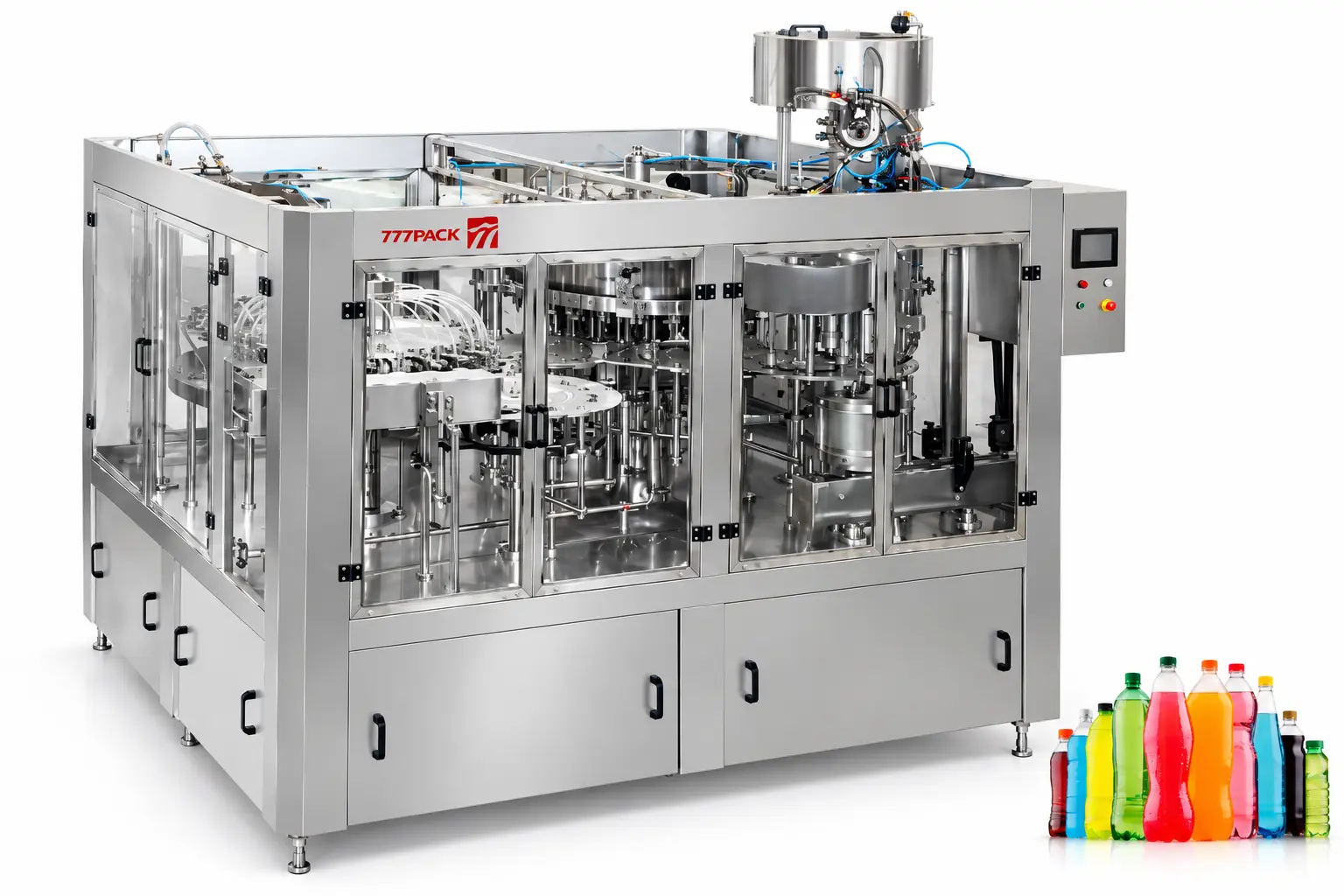
PET Bottle Carbonated Drink Filling Machine
Model:DXGF
Automatic 3-in-1 rinsing, counter-pressure filling and screw-capping monoblock for carbonated soft drinks in PET bottles, with standard output from 3,500 to 28,000 BPH.
- Capacity Range
- 3500–28000 BPH
- Suitable Products
- Carbonated Drink
- Bottle Range
- 200–2000 ml
- Functions Included
- Rinse · Counter-Pressure Fill · Cap
- Main Material
- SUS304; SUS316L product-contact parts
- Closure
- Plastic Screw Cap



Line Integration
Position in the Production Line
The current process is highlighted. Actual line configuration is customized to your product, container, output and site conditions.
- Parallel preparation The following stages operate in parallel.
-
-
04 Warming Warm · Reduce Condensation
-
Reference flow only. Final process and equipment scope are customized to product, container, formula, capacity, and local requirements.
Installed after beverage preparation, carbonation and empty-bottle supply, the DXGF monoblock rinses PET bottles, fills carbonated product under counter pressure, applies screw caps, and discharges sealed bottles to warming, drying, coding, labeling and packing.
- Bottle Infeed: Neck-handling air conveyor from bottle blower or empty-bottle supply
- Bottle Discharge: Capped-bottle conveyor to warmer, dryer and downstream packaging
- Product & CO₂ Supply: Stable chilled carbonated beverage at the confirmed pressure, temperature and flow
- Line Controls: Speed synchronization, safety interlocks and upstream/downstream signal exchange
FILLING TECHNOLOGY
Filling Technology for Your Product
Product characteristics, container format, target output and process requirements determine the final configuration. We recommend the appropriate technology for each project.
Standard Isobaric Filling
Balances product and bottle pressure before filling to reduce foaming and CO₂ loss.
Ask About Standard CSD FillingHigh-CO₂ / Low-Temperature Package
Optimized product path and pressure settings for colder beverages and higher carbonation levels.
Configure for High CarbonationElectronic Valve Control
Recipe-based valve timing for flexible products, bottle sizes and production speeds.
Compare Electronic ControlTechnical Note. Rated output is based on the supplied reference configuration and a 500 mL PET bottle. Actual capacity depends on beverage temperature, carbonation level, bottle geometry, cap, utilities and complete-line efficiency. Final values are confirmed after bottle, cap and recipe review.
Model Comparison
DXGF Carbonated Drink Filling Machine Models
DXGF configurations for PET-bottled carbonated drinks. Select the model against the approved beverage, CO₂ volume, bottle, cap and required output.
| Model | Rated Output | Filling Process | Dimensions (L × W × H) | Installed Power | Rinse / Fill / Cap Heads |
|---|---|---|---|---|---|
| DXGF14/12/5 | 3,500 BPH | Counter-Pressure Filling | 2360 × 1770 × 2700 mm | 1.5 kW | 14 / 12 / 5 |
| DXGF16/16/5 | 5,000 BPH | Counter-Pressure Filling | 2760 × 2060 × 2700 mm | 2.2 kW | 16 / 16 / 5 |
| DXGF24/24/8 | 8,000 BPH | Counter-Pressure Filling | 2800 × 2230 × 2700 mm | 3 kW | 24 / 24 / 8 |
| DXGF32/32/8 | 12,000 BPH | Counter-Pressure Filling | 4215 × 2960 × 2700 mm | 4 kW | 32 / 32 / 8 |
| DXGF40/40/10 | 15,000 BPH | Counter-Pressure Filling | 4360 × 3300 × 2700 mm | 7.5 kW | 40 / 40 / 10 |
| DXGF50/50/12 | 18,000 BPH | Counter-Pressure Filling | 5900 × 3300 × 2700 mm | 7.5 kW | 50 / 50 / 12 |
| DXGF60/60/15 | 21,000 BPH | Counter-Pressure Filling | 5770 × 5288 × 2700 mm | 11 kW | 60 / 60 / 15 |
| DXGF72/72/18 | 28,000 BPH | Counter-Pressure Filling | 6540 × 4900 × 2700 mm | 11 kW | 72 / 72 / 18 |
Note. Rated output follows the supplied reference table and should be confirmed with the actual beverage, carbonation level, product temperature, bottle and cap. Final dimensions and utilities are subject to engineering review.
Equipment Overview
The DXGF Series PET Bottle Carbonated Drink Filling Machine integrates bottle rinsing, counter-pressure filling and screw capping in one enclosed rotary monoblock. Isobaric filling reduces foaming and CO₂ loss while maintaining a stable fill level.
Designed for cola, soda, sparkling water and other carbonated soft drinks, this CSD filling machine offers eight standard configurations from 3,500 to 28,000 BPH. It can be integrated with beverage preparation and carbonation systems, PET bottle blowing, bottle warming and drying equipment, coding, labeling and packing systems.
Final valve, pressure and utility settings are confirmed against the beverage recipe, CO₂ volume, bottle, cap and required output.
Engineering Highlights
Practical design details that affect operation, changeover, hygiene and maintenance.
3-in-1 Counter-Pressure Monoblock
Rinse · Isobaric Fill · CapRinsing, isobaric filling and screw capping are integrated in one enclosed rotary machine.
CO₂ Retention & Foam Control
Cold & Stable FillingPressure-balanced filling and controlled venting reduce product breakout and carbonation loss.
Stable PET Neck Handling
200–2,000 mL PETPET bottles are transferred by the neck for stable movement and efficient format changeover.
Scalable DXGF Series
3,500–28,000 BPHEight standard configurations cover different production targets with one operating concept.
Working Principle
- Empty PET bottles enter by neck-handling air conveyor and are transferred to the rinser.
- Bottles are inverted and rinsed with hygienic water.
- Each bottle is pressurized to match the product tank before chilled carbonated beverage enters through isobaric filling valves.
- Pressure is released in a controlled sequence to limit foaming and CO₂ loss.
- Caps are sorted, fed and applied with controlled torque, then bottles discharge to warming, drying, coding, labeling and packing.
The Siemens PLC and HMI coordinate product pressure, temperature, filling, capping and line-speed interlocks.
Core Specifications
| Nominal Output | 3,500–28,000 BPH |
|---|---|
| Reference Container | 500 mL round PET bottle |
| Bottle Volume | 200–2,000 mL |
| Suitable Products | Carbonated soft drinks, soda and sparkling water |
| Filling Process | Counter-pressure / isobaric filling |
| Typical Product Temperature | 2–5 °C |
| Closure | Plastic screw cap |
| Rinse / Fill / Cap Heads | 14 / 12 / 5 to 72 / 72 / 18 |
| Installed Power | 1.5–11 kW |
| Machine Dimensions (L × W × H) | 2,360 × 1,770 × 2,700 to 6,540 × 4,900 × 2,700 mm |
Standard Configuration
- 3-in-1 Rotary Monoblock
Integrated bottle rinsing, counter-pressure filling and screw capping in one enclosed machine.
- PET Neck-Handling Transfer
Transfers bottles by the neck for stable movement and efficient format changeover.
- Isobaric Filling Tank & Valves
Pressure-balanced filling path controls foam, fill level and CO₂ retention.
- Cap Sorting & Capping System
Automatic cap sorting, chute delivery and controlled screw-cap application.
- Siemens PLC + HMI
Central control of pressure, temperature, filling, speed synchronization, alarms and recipes.
- Safety Enclosure & Interlocks
Stainless guarding, emergency stops, no-bottle/no-fill protection and door interlocks.
Optional Configuration
- Additional Bottle & Cap Change Parts
Format parts for extra approved bottle profiles, volumes, neck finishes or caps.
- High-CO₂ / Low-Temperature Package
Pressure-control and product-path configuration for colder beverages or higher carbonation.
- CIP Interface & Dummy Bottles
Connections and accessories for automated cleaning of the filling circuit.
- Electronic Valve Control
Recipe-based valve timing for flexible products, bottle sizes and production speeds.
Core equipment manufacturing, auxiliary-machine coordination and complete-line integration are managed as one system to reduce interface risks before delivery.
Project checks before packing and delivery.
On-site setup, testing and operator training.
Local coordination for service and spare parts.
Before You Decide
Frequently Asked Questions
Answers to common questions about selection, integration and project planning.
What products can this PET bottle carbonated drink filling machine handle?+
It is designed for cola, soda, sparkling water and other carbonated soft drinks in PET bottles. The beverage recipe, CO₂ volume, product temperature, bottle and cap are reviewed before the final configuration is confirmed.
Why is counter-pressure filling used for carbonated drinks?+
The bottle is pressurized before filling so the pressure remains close to the product tank pressure. This limits foaming and CO₂ loss while supporting a stable fill level.
How is the rated production capacity calculated?+
The listed 3,500–28,000 BPH output follows the supplied model table and a reference 500 mL PET bottle. Actual speed varies with bottle volume, carbonation level, product temperature, cap and complete-line efficiency.
Can one machine handle different PET bottle sizes?+
Yes. The standard page range is 200–2,000 mL. Suitable change parts can be supplied for approved bottle profiles, volumes, neck finishes and caps.
Can the filler connect with an existing CSD bottling line?+
Yes. Product pressure and temperature, carbonation supply, infeed height, conveyors, bottle warming, dryer, operating speed and control signals are engineered after the existing line is reviewed.
What product temperature and carbonation data are required?+
Please provide the beverage type, target CO₂ volume, supply temperature, Brix or viscosity, and any special foaming characteristics. These values determine the filling pressure, valve timing and buffer-tank design.
Is a bottle warmer required after filling?+
It is normally recommended when the product is filled cold and condensation would affect coding, labeling or packing. The required warming temperature and residence time are confirmed with the bottle and line speed.
What information is needed for a filling machine proposal?+
Please send the beverage specification, target output, bottle and cap samples or drawings, and destination electrical standard. Existing-line drawings are also required for an integration or replacement project.
Let us match the right equipment solution.
Send these four project details. We will recommend the technology, output configuration and line connection plan.