Technical Guides
How Does a 3-in-1 Water Filling Machine Rinse, Fill, and Cap PET Bottles?
Published
A 3-in-1 water filling machine combines three essential steps, but its compact layout can make supplier comparisons harder. Buyers may see an attractive speed rating without knowing how bottles transfer, how filling stays consistent, or how caps seal. Understanding each station helps buyers set clearer specifications and more useful acceptance tests.
A 3-in-1 water filling machine rinses empty PET bottles, fills them with still water, and applies screw caps within one integrated rotary unit. In a typical neck-handling design, grippers invert bottles for rinsing and drainage, then transfer them upright through the filling and capping stations before discharge.
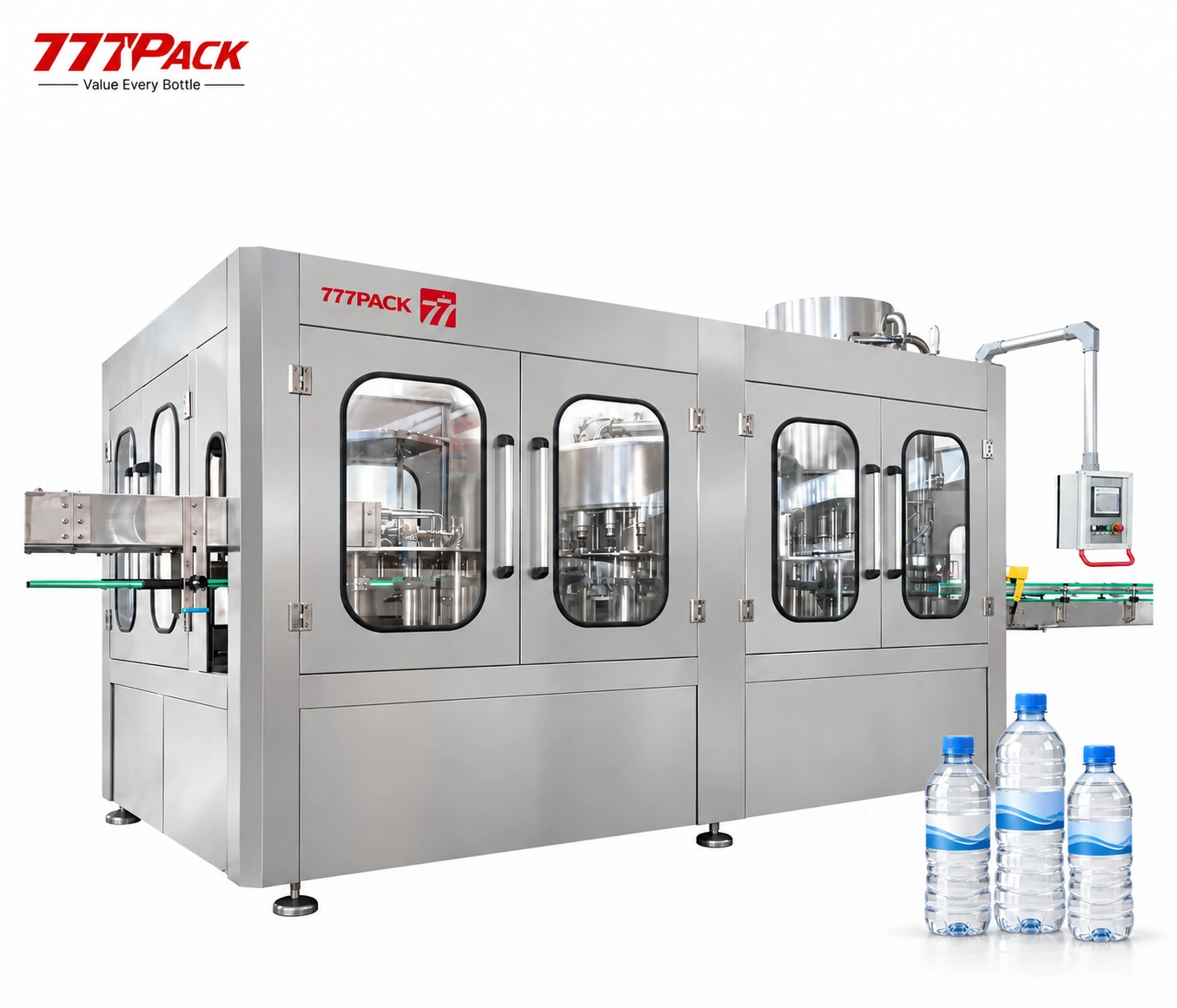
The operating sequence is straightforward. The purchasing decision needs more detail. Bottle geometry, water supply, closure compatibility, and downstream capacity all affect the result. The sections below explain the process and show which checks make a machine trial more meaningful.
How Does a 3-in-1 Water Filling Machine Rinse PET Bottles?
Empty PET bottles can collect loose particles during handling and transfer.1 A quick spray does not, by itself, establish adequate container hygiene. Buyers need to understand how the rinser grips each bottle, directs rinse water inside, and allows drainage before filling.
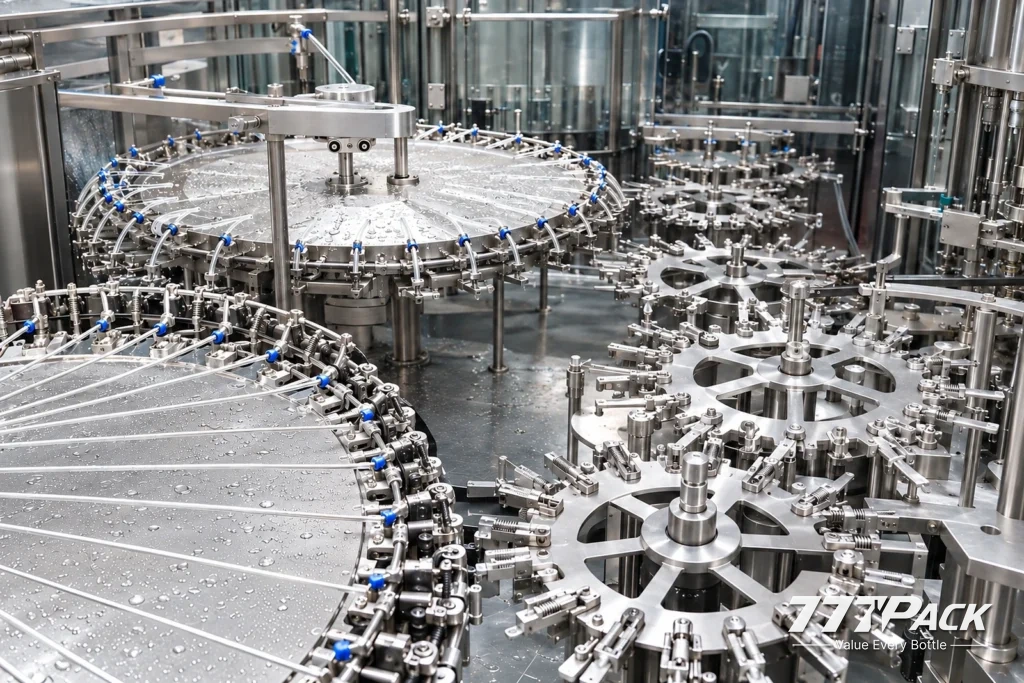
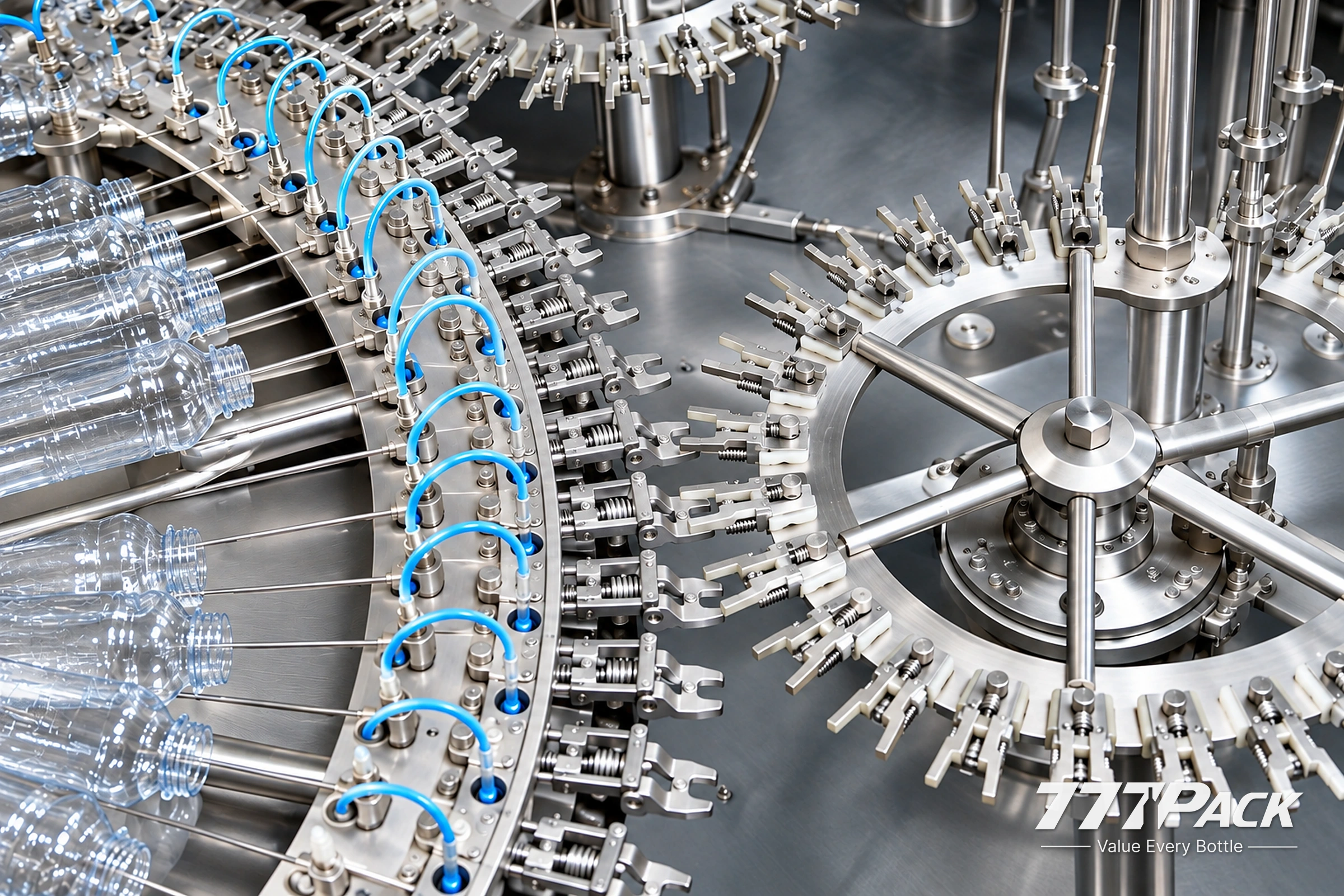
The rinsing station of a 3-in-1 water filling machine grips each PET bottle near its neck and turns it mouth-down. A nozzle sprays suitable treated rinse water into the bottle. The bottle remains inverted for drainage, then returns upright and transfers to the filling carousel.
Bottle handling matters as much as the spray
A typical rotary rinser uses grippers and a guided turning mechanism to invert bottles as the carousel rotates. The machine must hold the bottle securely without damaging the neck area or disrupting transfer.
Neck handling can help accommodate different bottle bodies, but it does not make every PET bottle interchangeable. Buyers should submit actual bottles and neck drawings for compatibility review. Different heights, shoulder shapes, and lightweight bottle designs may require adjustments or change parts.2
During a trial, buyers should check that:
- The grippers hold bottles consistently throughout inversion.
- The rinse nozzles align with the bottle openings.
- The bottles drain before they return upright.
- The transfer points do not produce repeated jams or bottle damage.
- The machine handles the agreed bottle formats at the contracted speed.
The trial should use representative production bottles, not only unusually rigid or carefully selected samples.
Rinsing is part of a larger hygiene system
Rinsing helps remove loose particles. It should not automatically be described as sterilization or as a complete sanitation process.
The Codex code of hygienic practice for packaged drinking water addresses container inspection, cleaning and disinfection where needed, and protection against contamination during filling and sealing. Its scope should also be checked against the product category; this particular code excludes natural mineral waters.
A suitable container-preparation approach depends on the incoming bottles, water quality, plant environment, and hygiene program. Qualified food-safety and process professionals should evaluate those application-specific requirements.
For a 3-in-1 water filling machine, the procurement specification should identify the rinse-water source, intended rinse arrangement, drainage expectations, and required cleaning access. Buyers should also ask how the supplier prevents unsuitable rinse water from becoming an uncontrolled contamination source.
A visible rinse spray demonstrates water flow. It does not, on its own, demonstrate microbiological suitability.3
How Does a 3-in-1 Water Filling Machine Fill Bottles Consistently?
A filling carousel can rotate smoothly while still producing inconsistent bottles. Unstable water supply, unsuitable settings, or bottle variation can affect the result. Buyers therefore need to evaluate the filling method and sampled output, rather than judging performance from machine movement alone.
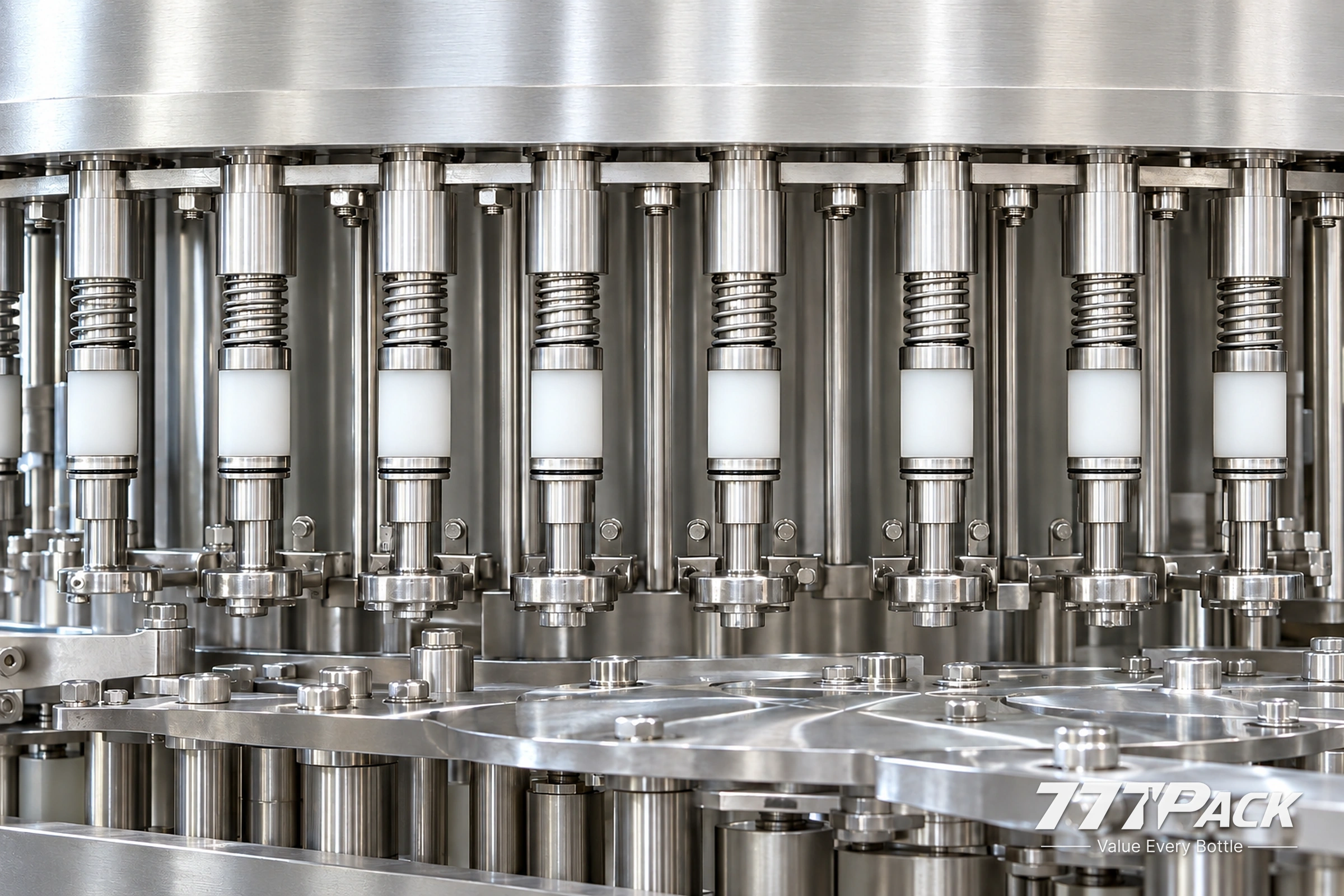
In an atmospheric gravity configuration, a 3-in-1 water filling machine positions upright bottles beneath filling valves. Treated water flows from the filler tank into each bottle under gravity. Suitable valve settings, stable supply conditions, and correct bottle handling support consistency.4 The supplied 777Pack design also includes a no-bottle/no-fill control.
The filling method should match the product
Atmospheric gravity filling is used for suitable non-carbonated water applications. Buyers should confirm the actual filling principle in the supplier’s quotation because an integrated machine layout does not define every detail of its filling technology.
Still water and carbonated beverages have different process requirements.5 A machine proposed for bottled still water should not be assumed suitable for carbonated products without a separate technical evaluation.
The 777Pack PET bottle water filling machine product page provides the supplied design context for filling methods, bottle compatibility, and available configurations. Buyers should turn those descriptions into a project-specific specification.
Important questions include:
| Evaluation point | What buyers should establish |
|---|---|
| Product compatibility | The machine is suitable for the intended water product and process conditions. |
| Bottle range | The supplier has reviewed actual samples and dimensioned drawings. |
| Filling acceptance | The parties have agreed on nominal volume, tolerance, and measurement method. |
| Missing bottles | The proposed controls prevent filling at unoccupied positions. |
| Cleaning access | The design supports the plant’s approved cleaning and hygiene procedures. |
Water demand needs a complete calculation
According to the supplied Bogor bottled water line case study, the Indonesian project was designed for 15,000 bottles per hour using 700 mL PET bottles.
The Bogor line uses 200 mL of rinse water per bottle in the design calculation.
| Water use | Calculation at the design rate | Water demand |
|---|---|---|
| Filling | 15,000 bottles/h × 0.700 L/bottle | 10,500 L/h |
| Bottle rinsing | 15,000 bottles/h × 0.200 L/bottle | 3,000 L/h |
| Filling and rinsing combined | 10,500 L/h + 3,000 L/h | 13,500 L/h (13.5 m³/h) |
The line is equipped with a 15 T/h water treatment system. The combined demand above covers filling and bottle rinsing at the design speed.
Rinsing, cleaning, other plant uses, and treatment losses must also enter the water-supply assessment.6 Buyers should ask qualified process engineers to check both average demand and relevant peak conditions.
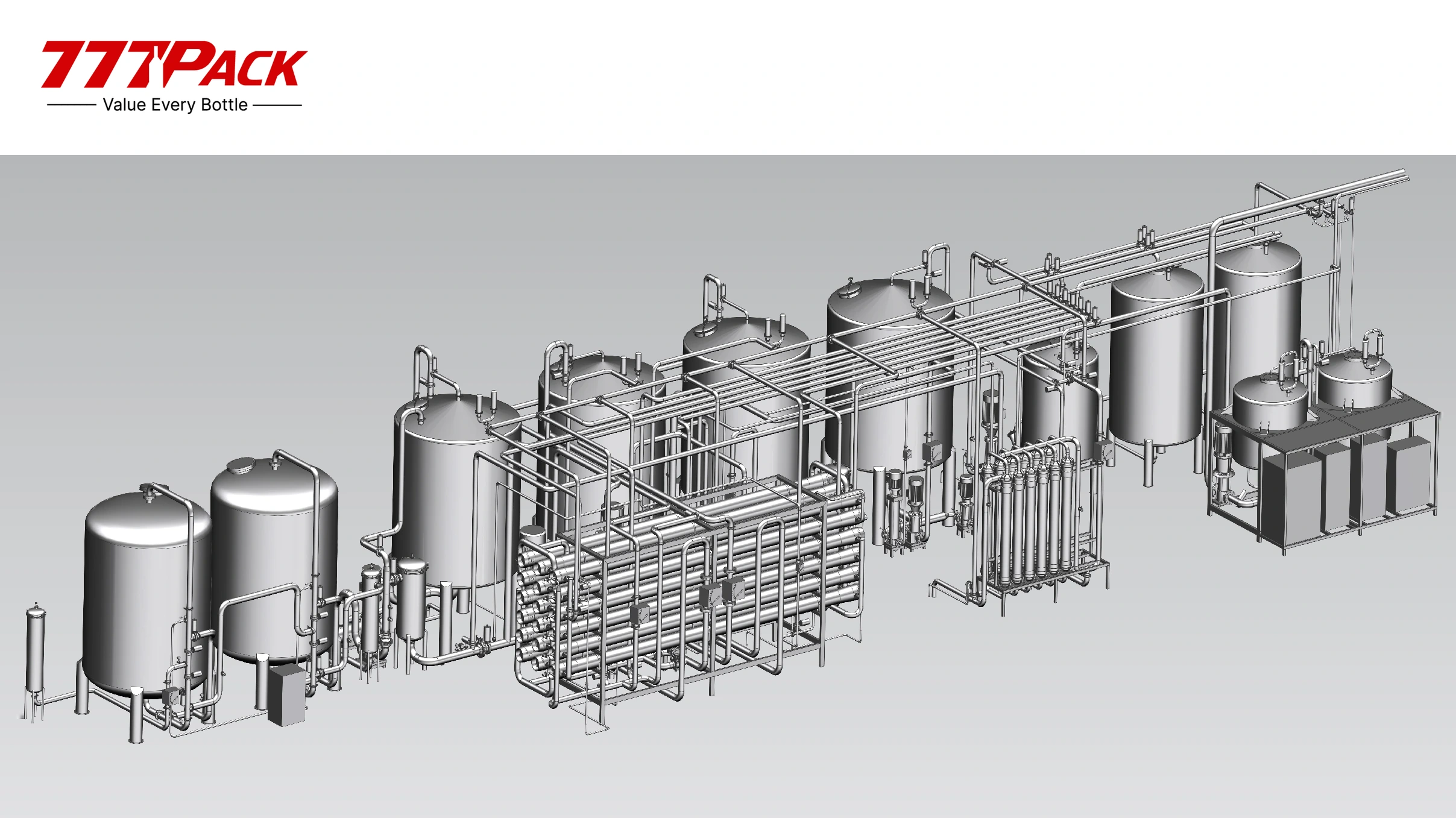
Example water treatment configuration for a bottled water line.
Fill volume needs a defined test
A similar-looking fill level is useful for visual inspection, but it does not establish that every bottle meets the agreed volume requirement. Bottle shape and manufacturing variation can affect the appearance.
The acceptance plan should define the sampling frequency, test method, instrument suitability, operating speed, and pass criteria. When the test uses weighing to assess volume, the procedure should account for bottle tare and relevant water-density conditions.7
A 3-in-1 water filling machine should be evaluated under representative operating conditions, including startup and an agreed sustained run. A short demonstration may not reveal variation that appears after the line settles into production.8
How Does a 3-in-1 Water Filling Machine Apply and Tighten Caps?
A bottle can leave the filler with the correct water volume and still fail because of its closure. A crooked cap, damaged thread, or unsuitable tightening setting can undermine package integrity. Buyers should therefore evaluate the bottle, cap, and capping head as a connected system.
The capping station of a 3-in-1 water filling machine receives oriented screw caps from a feeder and places them onto filled bottles. Each capping head engages the closure with the bottle threads and tightens it. Buyers should verify cap seating, leakage, and any agreed torque requirements on representative samples.
The neck finish defines the connection
The neck finish describes the bottle-mouth geometry that must match the closure.9 Buyers should confirm this interface through drawings and physical samples, rather than relying only on a general bottle-size description.
The supplied Bogor bottle specifications identify a 29/25 neck finish for that project. This is a project-specific detail, not a universal specification for all bottled-water lines.
A closure review should cover:
- The bottle neck drawing and relevant dimensions.
- The cap drawing and intended sealing arrangement.
- The tamper-evident features, where applicable.
- The cap’s compatibility with the feeder and delivery path.
- The bottle and cap suppliers’ agreed tolerances.
A cap that appears to fit by hand may still behave differently during high-speed feeding and tightening.
Cap feeding deserves its own inspection
The feeder must orient caps and supply them consistently to the capping station. An otherwise capable filler can lose output when caps bridge, arrive incorrectly, or stop feeding.
Buyers should observe cap delivery during a sustained trial. The test should include the actual closure planned for production and should assess how the machine responds to interrupted supply.
The supplier should explain which missing-cap or cap-related detection features are included. Buyers should not assume that every proposal includes automatic inspection or rejection.
Torque and leakage answer different questions
Cap seating, leakage, and removal torque provide different information. A cap can look straight without meeting the package’s sealing requirements. A high removal-torque reading also does not automatically prove that the package is acceptable.10
When removal torque forms part of acceptance testing, the parties should agree on the measurement timing, sample conditioning, instrument, and method. ASTM D2063/D2063M-24 provides a manual torque-retention test method for packages with continuous-thread closures.
The standard does not establish a universal torque target for every bottle-and-cap combination. Qualified packaging professionals and the closure supplier should help define application-specific limits.
For a 3-in-1 water filling machine, the acceptance agreement should state both the closure settings and the tests used to judge the finished package.
How Should Buyers Match a 3-in-1 Water Filling Machine to the Complete Line?
An integrated filler cannot deliver its planned output if bottles arrive irregularly or finished bottles cannot leave.11 Buyers who compare only the filler’s rated speed may overlook bottlenecks elsewhere. A complete-line review connects treatment, bottle blowing, conveyors, labeling, and packing to the same production target.
A 3-in-1 water filling machine normally operates between upstream water treatment and bottle supply, and downstream coding, labeling, and secondary packaging. Buyers should compare usable equipment capacities for the same bottle and pack formats, then evaluate conveyor accumulation, utility demand, changeovers, and local service support.
The Bogor project illustrates the equipment sequence
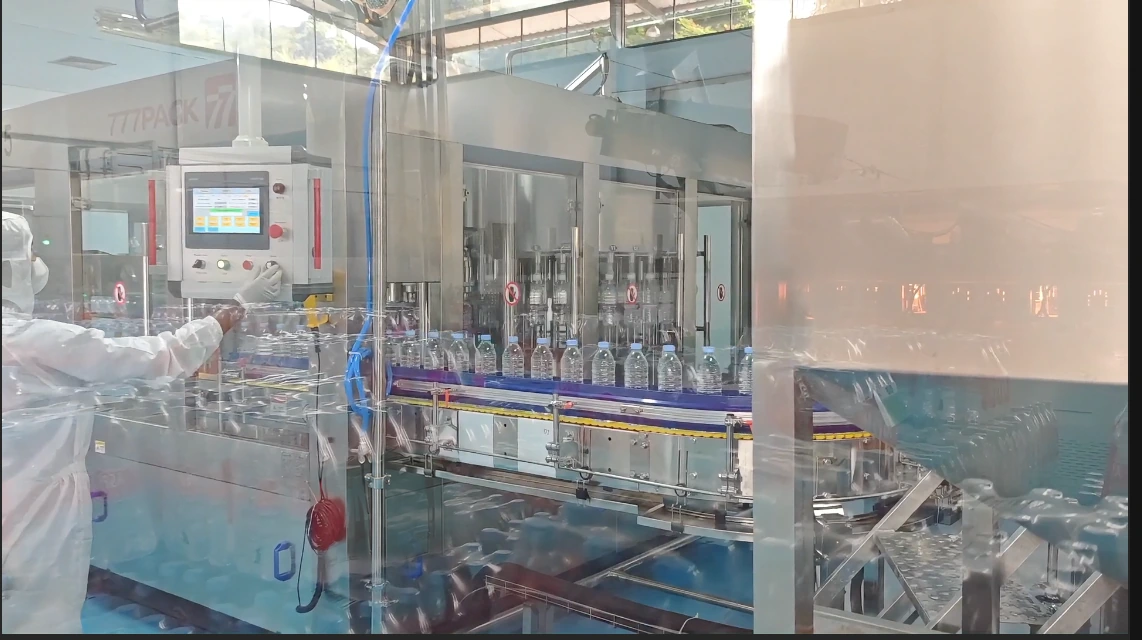
According to the supplied Bogor case study, an air conveyor carries freshly blown PET bottles to the filling machine. Treated spring water arrives through a separate pipe. After capping, bottles move to coding, labeling, and film wrapping.
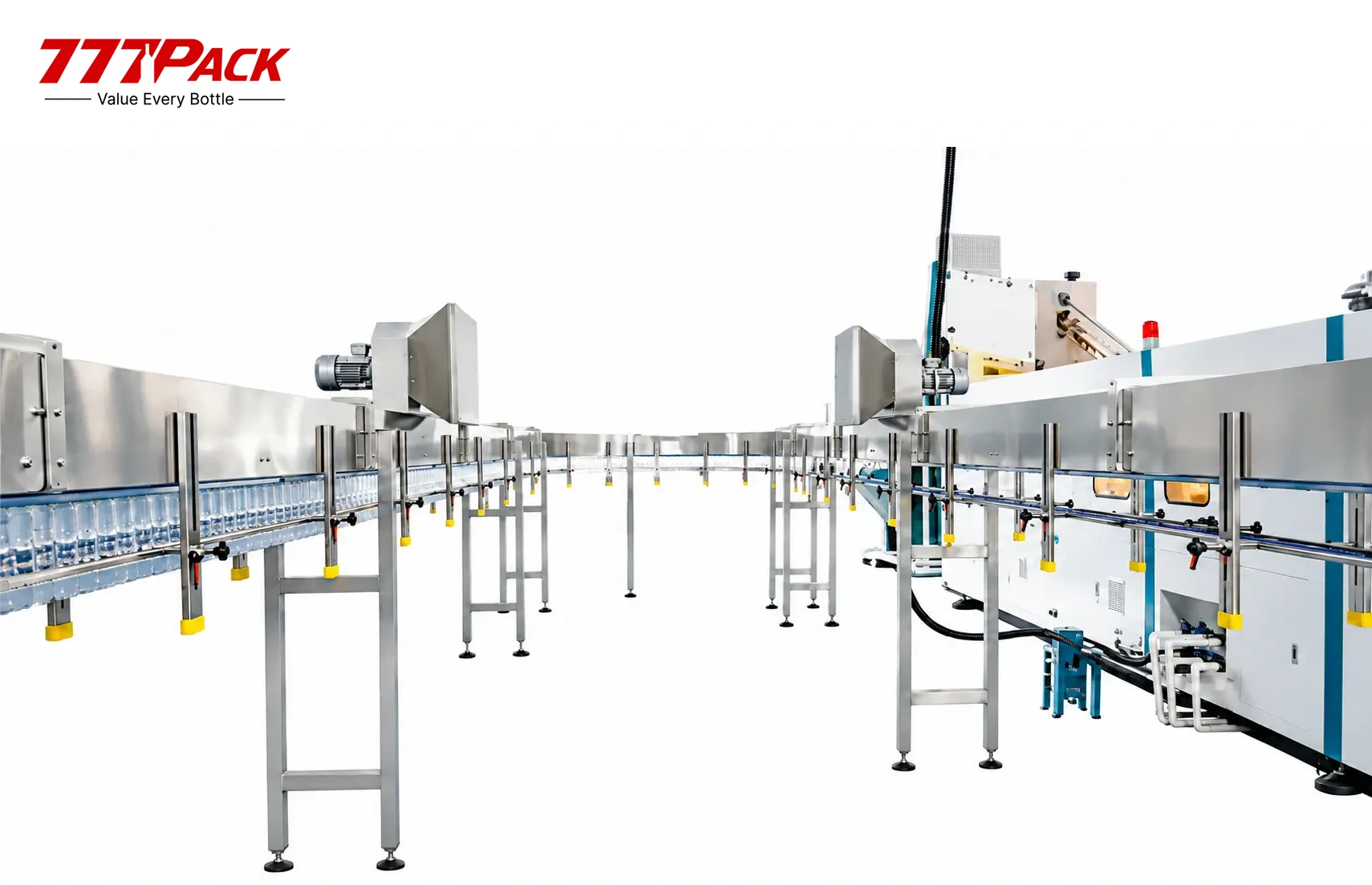
Example air conveyor layout for moving empty PET bottles from the blow molder to the filler.
The documented sequence provides a useful procurement checklist:
| Line stage | Main purchasing consideration |
|---|---|
| Water treatment | The system provides suitable water quality and sufficient capacity. |
| Bottle blowing | The equipment produces compatible bottles at the required output. |
| Air conveying | The conveyor transfers bottles reliably to the rinser inlet. |
| Rinsing, filling, and capping | The integrated unit meets agreed bottle and package-quality criteria. |
| Coding and labeling | The equipment handles the intended bottle and presentation format. |
| Film wrapping | The wrapper supports the selected pack arrangement and line output. |
The project video offers a visual reference for the line arrangement. A video can help buyers understand equipment flow, but it does not replace a witnessed acceptance test.
Capacity comparisons need matching units
The Bogor bottled water line case study reports that labeling and film wrapping were sized for more than 18,000 bottle equivalents per hour. That is more than 20% above the line’s 15,000-bottle-per-hour design rate.
For a wrapper quoted in packs per minute, buyers can use:
Bottle equivalents/hour = packs/minute × bottles/pack × 60
For example, a hypothetical wrapper producing 25 packs per minute with 12 bottles per pack represents:
25 × 12 × 60 = 18,000 bottle equivalents/hour
This conversion supports a fair comparison. It does not prove sustained production, because pack format, film handling, stoppages, and operating conditions still matter.
Supplier selection should include practical support
A 3-in-1 water filling machine is a long-term production asset. Buyers should examine spare-parts availability, installation responsibilities, training, documentation, and service response arrangements alongside the purchase price.
The supplied business context states that 777Pack serves global markets and has a company in Indonesia providing local service. Indonesian buyers should confirm which support activities are available locally, who performs them, and what the contract covers.
Certificates should be treated as documents to verify. Buyers should check the issuer, validity, scope, and relationship to the offered equipment. A certificate alone does not establish that a machine suits a specific application or meets every destination-market requirement.12
A stronger comparison combines documented capability with sample trials, defined acceptance criteria, and a clear support agreement.
Frequently Asked Questions
Is a 3-in-1 water filling machine suitable for every PET bottle?
No. Compatibility depends on the neck finish, bottle height, body geometry, and handling characteristics. Buyers should provide dimensioned drawings and physical samples. The supplier should identify required adjustments or change parts and demonstrate the agreed bottle formats during testing.
Does bottle rinsing sterilize the container?
A treated-water rinse should not automatically be described as sterilization. It can help remove loose particles, but hygiene suitability depends on the full container-preparation and contamination-control system. Qualified food-safety professionals should evaluate whether additional cleaning or disinfection is necessary for the intended application.
What should a factory acceptance test include?
A factory acceptance test should cover representative bottles and caps, agreed running speed, fill-volume checks, cap seating, leakage, and specified control functions. The written plan should define run duration, sampling methods, instruments, pass criteria, and corrective action when results fall outside the agreed limits.
Can the same machine fill carbonated water?
A machine specified for atmospheric gravity filling of still water should not be assumed suitable for carbonated water. Carbonated products require an appropriate filling design and process conditions. Buyers should request a separate application review rather than treating carbonation as a simple setting change.
Why does local service matter for an Indonesian bottling plant?
Local support can make communication, site visits, training, and spare-parts coordination easier. Buyers should still verify the actual service scope. The agreement should explain response arrangements, technician availability, parts stocking, warranty responsibilities, and which activities require support from overseas.
Technical references
- Codex Alimentarius, FAO and WHO: Code of hygienic practice for bottled/packaged drinking waters other than natural mineral waters, CXC 48-2001.
- ASTM International: Manual torque-retention testing for packages with continuous-thread closures, ASTM D2063/D2063M-24.
Conclusion
A 3-in-1 water filling machine integrates bottle rinsing, still-water filling, and screw capping, but buyers should evaluate more than its rated speed. Reliable procurement depends on bottle compatibility, suitable hygiene controls, defined filling and closure tests, and balanced line capacity. The supplied Bogor project offers a practical reference for these checks. When requesting a project-specific proposal for the 777Pack PET bottle water filling machine, provide the intended bottle drawings, cap samples, output target, and installation location. Ask 777Pack to confirm the available Indonesian or international service support.
"Food Packaging and Chemical Migration - PMC - NIH", https://pmc.ncbi.nlm.nih.gov/articles/PMC12096275/. Food-hygiene guidance recognizes container handling and storage as potential contamination pathways and calls for packaging materials to be protected before use; this supports the stated risk but does not quantify particulate contamination in PET bottles. Evidence role: general_support; source type: institution. Supports: Food-contact containers require protection from contamination during storage, handling, and preparation for filling.. Scope note: General hygiene guidance does not establish the frequency or amount of particulate contamination in a particular bottling operation. ↩
"Research on the Structure of the PET Bottle Bottom Based on ...", https://pmc.ncbi.nlm.nih.gov/articles/PMC9371001/. Studies of lightweight PET bottles show that geometry and material distribution influence deformation and load-bearing behavior, providing an engineering basis for evaluating handling compatibility with actual bottle formats. Evidence role: general_support; source type: paper. Supports: Bottle geometry and material distribution influence structural behavior and may affect handling compatibility.. Scope note: Bottle-mechanics research does not establish which adjustments or change parts a particular filling machine requires. ↩
"Food safety", https://en.wikipedia.org/wiki/Food_safety. Food-safety validation guidance distinguishes observation of a control measure from evidence that it achieves its intended hazard-control outcome; visible rinse flow alone therefore cannot establish microbiological suitability. Evidence role: general_support; source type: institution. Supports: Microbiological suitability requires evidence about water quality and the effectiveness of relevant hygiene controls, rather than observation of flow alone.. Scope note: General validation principles do not specify a validated rinse process or microbiological acceptance limits for this machine. ↩
"Venturi effect", https://en.wikipedia.org/wiki/Venturi_effect. Hydrostatic and orifice-flow principles relate gravity-driven discharge to liquid head and flow-path characteristics, explaining why supply stability and valve conditions can affect filling performance. Evidence role: mechanism; source type: education. Supports: Gravity-driven flow depends on pressure head and flow-path conditions, making supply and valve conditions relevant to filling consistency.. Scope note: These principles provide contextual support for the flow-related factors, not direct proof of bottle-handling effects or the accuracy of this filler. ↩
"Carbon dioxide", https://en.wikipedia.org/wiki/Carbon_dioxide. Henry's law and gas-solubility principles explain why depressurization can release dissolved carbon dioxide, providing a physical basis for pressure and temperature control during carbonated-beverage filling. Evidence role: mechanism; source type: education. Supports: Dissolved carbon dioxide responds to pressure and temperature changes, creating filling requirements distinct from those of still water.. Scope note: Gas-solubility principles do not determine whether any specific machine can be adapted for carbonated products. ↩
"Point-of-Use Reverse Osmosis Systems", https://www.epa.gov/watersense/point-use-reverse-osmosis-systems. Food-and-beverage water-management guidance accounts for water incorporated into products alongside cleaning, auxiliary process uses, and treatment or discharge streams; nominal packaged volume is therefore not a complete plant-water balance. Evidence role: general_support; source type: institution. Supports: Industrial water balances include product water, cleaning and process uses, and losses or reject streams.. Scope note: The guidance does not quantify the additional water demand of the cited Bogor project. ↩
"Handbook 133 – 2026 Chapter 3. Test Procedures", https://www.nist.gov/system/files/documents/2025/12/23/2026_NIST_HB133_Chapter3-20251216.pdf. Net-content measurement procedures determine liquid quantity from mass after accounting for packaging tare and use the liquid's density under the relevant measurement conditions when converting mass to volume. Evidence role: mechanism; source type: government. Supports: Liquid volume can be calculated from net liquid mass using density, with packaging tare excluded and relevant temperature conditions considered.. ↩
"Process or Product Monitoring and Control", https://www.nist.gov/publications/nistsematech-engineering-statistics-handbook-chapter-6-process-or-product-monitoring. Statistical process-monitoring guidance evaluates stability using time-ordered observations, supporting the distinction between a brief demonstration and evidence of sustained production consistency. Evidence role: general_support; source type: government. Supports: Assessing process stability requires observations over time capable of revealing shifts and other temporal variation.. Scope note: General statistical guidance does not prescribe an acceptance-run duration for this filling line. ↩
"3D printing", https://en.wikipedia.org/wiki/3D_printing. Packaging dimensional references describe the neck finish through the opening and closure-interface geometry, including dimensions relevant to thread engagement and sealing. Evidence role: definition; source type: institution. Supports: Neck-finish specifications describe dimensions of the bottle opening and closure interface, including thread and sealing-related geometry.. Scope note: Dimensional compatibility alone does not establish seal performance or high-speed capping suitability. ↩
"Standard Test Methods for Measurement of Torque ...", https://store.astm.org/d2063_d2063m-24.html. ASTM's separate methods for continuous-thread closure torque retention and gross leakage distinguish resistance to opening from leakage performance; a removal-torque result alone does not establish package integrity. Evidence role: general_support; source type: institution. Supports: Torque retention and leakage are distinct package characteristics evaluated by different test methods.. Scope note: The methods do not provide universal torque limits or complete acceptance criteria for every bottle-and-cap combination. ↩
"Efficient Buffer Design Algorithms for Production Line Profit ...", https://web.mit.edu/manuf-sys/www/oldcell1/theses/Shi-PhD-Thesis.pdf. Production-line research identifies starvation and blocking as mechanisms that reduce equipment utilization and system throughput, explaining why a filler’s standalone capacity does not guarantee equivalent line output. Evidence role: mechanism; source type: paper. Supports: Serial production-line throughput is constrained by upstream starvation, downstream blocking, and intermediate buffer capacity.. Scope note: General production-line models do not quantify the achievable throughput of the specific bottling installation. ↩
"ISO 9000 family", https://en.wikipedia.org/wiki/ISO_9000_family. Conformity-assessment guidance evaluates compliance against identified requirements and intended uses, supporting the need to interpret certificates within their stated scope rather than as universal evidence of suitability. Evidence role: general_support; source type: government. Supports: Conformity evidence must be interpreted against its scope, intended use, and applicable regulatory requirements.. Scope note: Guidance from one jurisdiction does not establish the requirements of every destination market or validate a particular supplier's certificates. ↩