Technical Guides
How Much Does It Cost to Start a Bottled Water Plant? A Budget Guide from Idea to Real
Published
A bottled water plant can cost more than a first equipment quotation suggests.1 I understand why investors start with machine prices, but missing building work, permits, utilities, and operating cash can leave a project underfunded. I recommend building a complete project budget before deciding whether an equipment package is affordable.
I cannot give a reliable bottled water plant startup cost from production capacity alone.2 A complete budget combines supplier-quoted equipment and services, buyer-provided infrastructure, pre-launch expenses, and working capital. I recommend confirming the project scope first, then obtaining location-specific prices and permit timelines before making an investment decision.
I handle customer requirements and equipment quotations, so my focus is the boundary between what a supplier prices and what the buyer still needs to fund. I will explain how I organize those boundaries and which figures need local professional verification.
How Do I Build a Complete Bottled Water Plant Budget?
I often receive inquiries that begin with one question: “How much is the production line?” That question helps start a discussion, but it does not define the investment. I first separate the supplier’s quotation from the other costs needed to establish and operate the business.
I organize a bottled water plant budget into four groups: supplier-quoted equipment and services, buyer-provided infrastructure, pre-launch expenses, and working capital.3 I then identify who prices each item, who delivers it, and what remains unconfirmed. This approach makes missing responsibilities visible before I compare investment options.
I separate the equipment package from the business investment
An equipment quotation is a commercial offer for a defined scope. I do not treat it as a complete startup budget unless every additional responsibility has been identified and priced.
I use the following framework to organize early discussions:
| Budget category | Items I would check | Source I would use for verification |
|---|---|---|
| Supplier-quoted equipment and services | Agreed processing and packaging equipment, accessories, installation support, training, and spare parts | Supplier quotation and technical annex |
| Buyer-provided infrastructure | Land or lease, building work, electrical distribution, drainage, utility connections, and storage space | Local contractors, utilities, and qualified designers |
| Pre-launch expenses | Applicable permits, professional advice, inspections, testing, recruitment, and initial commercial preparation | Relevant authorities and local service providers |
| Working capital | Packaging materials, payroll, utilities, distribution expenses, and cash needed before customer payments arrive | Buyer’s operating plan and financial adviser |
I keep land acquisition, building construction, and lease costs separate. A rented building may reduce some initial spending, but it can still require substantial alterations. An owned site may introduce land-related obligations and construction approvals.
I record the pricing basis
For each budget entry, I record:
- I identify the currency and quotation date.
- I state whether taxes are included.
- I check freight, insurance, import duties, and local delivery.
- I record payment milestones and quotation validity.
- I label the amount as quoted, estimated, or still unverified.
This matters because two figures can look comparable while using different assumptions. A supplier’s factory-delivery price and an installed-site price do not describe the same purchase.
I keep uncertainty visible
I prefer a budget with clearly marked unknowns over a precise-looking total built from guesses. I also distinguish contingency from working capital. Contingency covers uncertainty in project spending; working capital supports business operations.4
I ask a qualified financial adviser to review financing costs, taxes, cash-flow assumptions, and the reserve needed for unresolved risks. My equipment quotation does not replace that review.
What Must I Define Before Requesting a Bottled Water Plant Equipment Quote?
An hourly output target sounds specific, but I cannot use it to define a complete equipment package. Different bottle sizes, packaging formats, and automation choices change the scope. If I quote before clarifying those requirements, the buyer may compare prices for fundamentally different production arrangements.
I need the bottle format, target output, planned operating schedule, packaging method, automation expectations, and equipment boundaries before preparing a meaningful quotation. For a bottled water plant, I also need to understand the available site and utilities. Qualified specialists must verify application-specific water quality and treatment requirements.
I begin with the product and production target
I ask buyers to describe what they intend to sell, not only how many bottles they want to produce.
My initial configuration questions include:
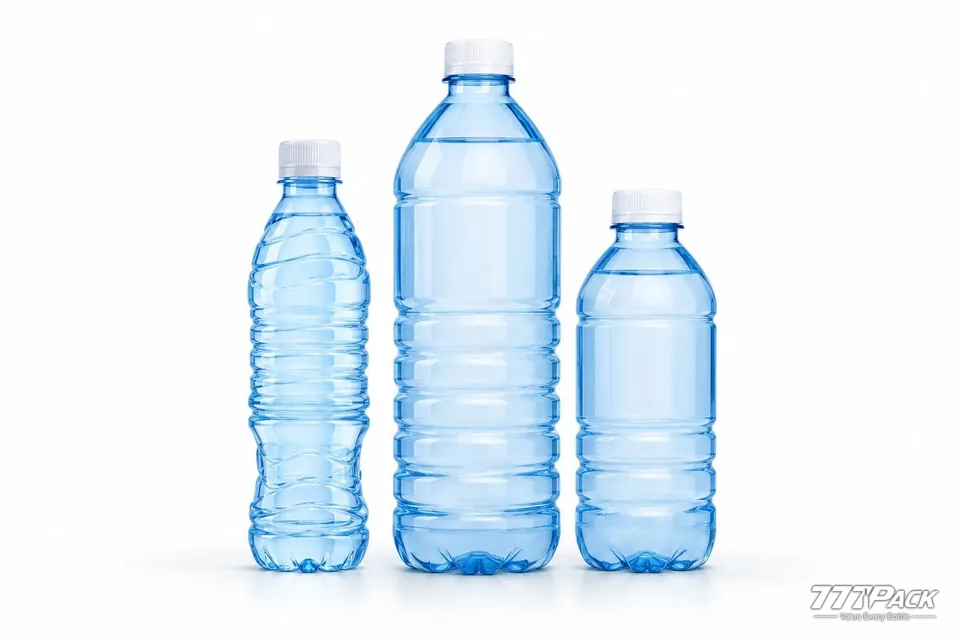
- Which bottle sizes will the business use? I request the intended formats, neck specifications, and available bottle drawings or samples.
- How will the business obtain bottles? I clarify whether it will buy finished bottles or include bottle-making equipment in the project.
- Which closure and label formats will it use? I need those choices to define the relevant packaging equipment.
- How will finished products be packed? I distinguish shrink-wrapped packs, cartons, and other agreed formats.
- What production schedule does the buyer expect? I separate an hourly target from daily and monthly production goals.
- How much manual handling is acceptable? I discuss labor expectations without promising an operating cost before local inputs are available.
I also separate nominal machine capacity from planned saleable output. Changeovers, cleaning, maintenance, and interruptions affect production planning. I ask suppliers to state the conditions behind their capacity claims rather than treating a brochure number as a business forecast.
I define where the quotation starts and ends
A “water production line” can mean different things to different suppliers. I therefore list the included equipment individually.
Depending on the agreed scope, I check whether the proposal includes bottle production, filling and capping, labeling, coding, secondary packaging, conveyors, inspection equipment, and supporting utilities. I do not assume that any item is automatically included.
I treat water-source assessment and treatment selection as separate technical questions.5 I request the relevant information, but I recommend qualified water-treatment and laboratory evaluation before application-specific decisions are finalized.
I connect equipment requirements to the site
I request available information about floor space, access, electricity, water supply, drainage, and utility provision. I then ask the supplier to document the selected equipment’s requirements.
This exchange helps a local engineering team evaluate suitability. It does not establish that an existing building or utility connection is adequate.
How Do I Budget for Permits, Utilities, and Building Work?
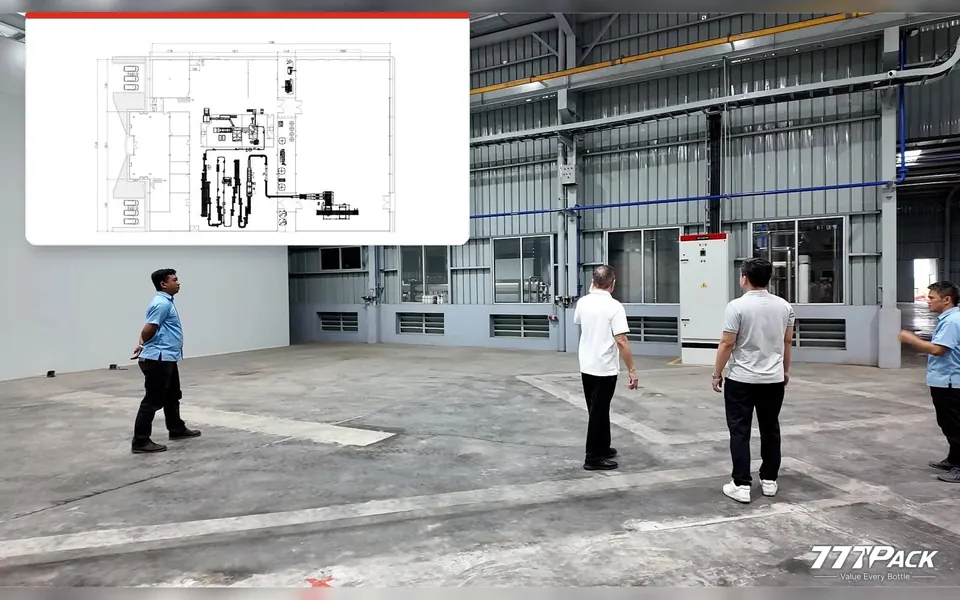
A machine delivery date does not determine when a business can open. I ask buyers to investigate permits, construction, and public utility connections early because these activities may follow separate approval processes. An overlooked connection or building requirement can affect both the investment budget and the launch schedule.
I budget permits, utilities, and building work as locally verified project items, not as standard additions to an equipment price. I request official fees, professional service quotations, construction estimates, and written scheduling assumptions. I also separate approval time from the time needed to prepare documents, complete work, and pass inspections.
I check which permits actually apply
I do not publish one universal permit list, fee, or completion period.6 Requirements depend on the country, municipality, site, water source, construction scope, and business activities.
Instead, I ask a local adviser to identify which requirements apply, potentially including:
- I check business registration and relevant operating approvals.
- I check land-use, building, and occupancy requirements.
- I check water abstraction or supply permissions where applicable.
- I check environmental, wastewater, and discharge requirements.
- I check food or beverage production licensing.
- I check applicable product registration, labeling, and testing requirements.
- I check fire-safety and workplace obligations.
I treat this list as a starting point, not a compliance determination.
I budget both permit fees and the work behind them
The published application fee may represent only part of the cost. I also ask about document preparation, qualified professional services, required testing, inspections, translations, and possible resubmissions.
I use a tracking table to keep cost and time questions together:
| Workstream | Cost information I request | Timing information I request |
|---|---|---|
| Business and production approvals | Official fees and adviser charges | Preparation time, review period, and prerequisites |
| Building approvals | Design, submission, and inspection costs | Approval stages and construction dependencies |
| Water and wastewater permissions | Application, studies, and testing costs | Review steps and required supporting evidence |
| Product-related approvals | Applicable registration and testing fees | Submission sequence and release conditions |
| Utility connections | Connection charges and upgrade quotations | Capacity confirmation and connection lead time |
I distinguish an authority’s stated processing period from the project’s total elapsed time. A review period may begin only after a complete application is accepted. I also ask which approvals can proceed in parallel and which depend on earlier decisions.
I include public utilities and recurring charges
For electricity, water, sewerage, and other required services, I check both initial connection costs and ongoing charges.
I ask the buyer’s local team to confirm available capacity, upgrade requirements, deposits, fixed charges, consumption tariffs, and any applicable demand charges. I request technical input on whether the selected equipment needs additional site infrastructure.
I obtain a site-specific building estimate
I ask a qualified local designer or contractor to assess the building scope. The estimate should address relevant production areas, storage, staff facilities, access, drainage, electrical work, and other applicable requirements.
I keep construction costs separate from equipment foundations, unloading, positioning, and connection work so those responsibilities do not disappear between quotations.
How Do I Compare Bottled Water Plant Supplier Quotations Fairly?
A lower quotation can be attractive, but I do not interpret price alone as evidence of quality or value. One supplier may include more equipment or services than another. I first align the scope, because an incomplete comparison can lead a buyer to fund unexpected items later.
I compare bottled water plant quotations by matching equipment lists, technical assumptions, exclusions, delivery terms, installation duties, acceptance criteria, and after-sales coverage. I ask each supplier to clarify missing items in writing. Only then do I compare price, payment conditions, and the remaining costs the buyer must arrange separately.
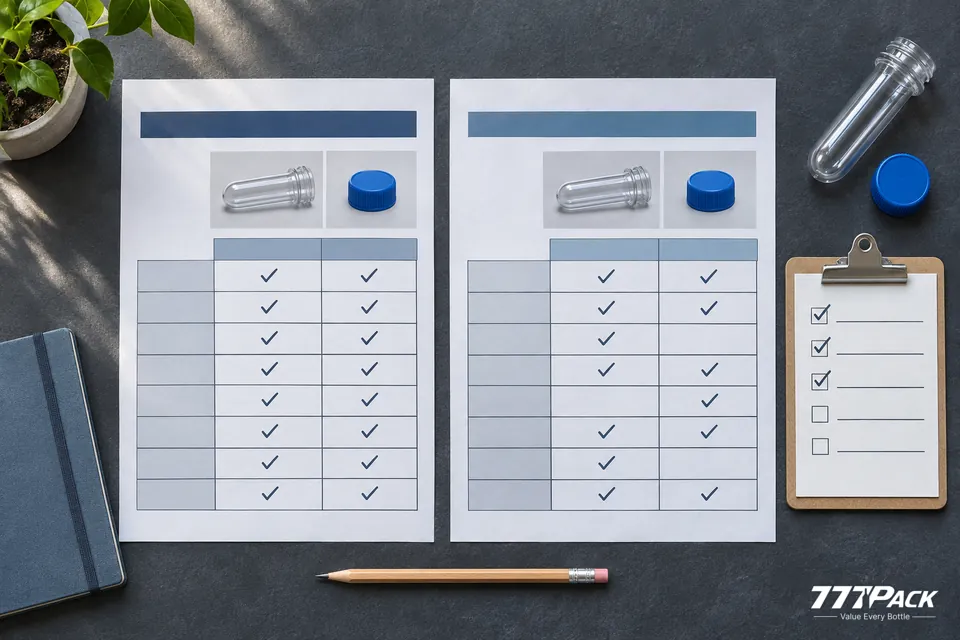
I build a scope comparison instead of comparing headline totals
I use a shared checklist so that each proposal answers the same questions.
| Comparison item | What I ask each supplier to confirm |
|---|---|
| Equipment scope | The quotation identifies every included machine and accessory. |
| Product assumptions | The proposal states the bottle, cap, label, and pack formats. |
| Capacity basis | The supplier states the conditions supporting the quoted output. |
| Site requirements | The supplier documents required utilities and installation conditions. |
| Installation | The offer states who handles unloading, placement, connections, and supervision. |
| Training | The supplier defines the included training scope and associated costs. |
| Acceptance | The agreement identifies checks, records, responsibilities, and test conditions. |
| Service | The supplier confirms coverage, support channels, exclusions, and charges. |
| Commercial terms | The offer states delivery terms, payment milestones, warranty terms, and validity. |
A blank cell is not a saving. I treat it as an unresolved question.
I review manufacturing quality evidence
I ask for equipment specifications, relevant material documentation, agreed inspection records, and a clear manufacturing and acceptance plan. I focus on evidence that relates to the actual equipment being purchased.
If a supplier presents a certificate, I recommend verifying its issuer, validity, scope, and relevance. A certificate does not automatically confirm product suitability or local regulatory acceptance.7
I also ask how the supplier handles deviations found during agreed inspections and who approves any changes to the specification.
I clarify service promises before relying on them
My business supplies beverage-packaging production lines for global markets, and we have a company in Indonesia for local service.8 I still confirm the actual support scope for each project rather than promising universal coverage.
I specify whether an offer includes remote assistance, site visits, installation supervision, training, or spare-parts support. I also clarify travel charges, accommodation responsibilities, response arrangements, and geographic limitations.
This distinction helps buyers compare documented service commitments, not general statements about support.
How Does a New Plant Budget Differ From an Expansion Budget?
An existing building or production line can make an expansion appear simple. I do not assume that existing assets are reusable without checking their condition and capacity. A first-time investor faces a different challenge: defining all the facilities and services that an established operator may already have.
I build a new bottled water plant budget from the full project scope. For an expansion, I start with a verified inventory of reusable assets and then price the gaps. I include integration, downtime, utility changes, and possible approval updates rather than limiting the budget to additional machinery.
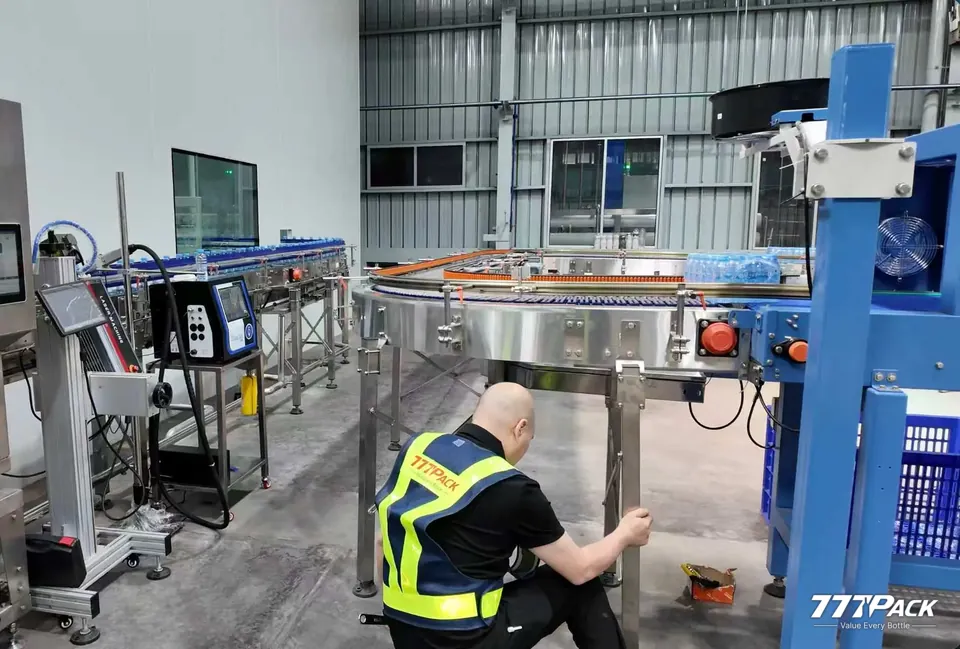
I establish what an existing operation can really reuse
I ask an existing operator for equipment details, maintenance information, layout drawings, utility data, and current production requirements. I then identify which reuse decisions need supplier or qualified engineering review.
My checks include:
- I ask whether existing machines support the proposed bottle and packaging formats.
- I check whether downstream equipment can accommodate the intended production target.
- I ask whether available utility capacity has been verified.
- I check whether storage and dispatch space can support the planned change.
- I ask whether controls, conveyors, and interfaces need modification.
- I check whether new activities trigger additional local approvals.
I do not count an asset as reusable merely because it is already on the site.9 Compatibility, condition, capacity, and applicable requirements all matter.
I budget integration work explicitly
A replacement filling machine may require conveyor changes, electrical work, revised layouts, or adjustments to upstream and downstream equipment. I ask each party to define its responsibilities before the order is placed.
I also ask the operator to estimate the commercial effect of installation downtime.10 The buyer’s operations and finance teams should verify that estimate. I do not promise that replacement work can occur without production interruption.
I give new investors a broader funding checklist
For a first-time investor, I include the costs of establishing an organization, not just assembling a line. Recruitment, training, initial packaging inventory, distribution preparation, and early operating expenses can all require funding.
I also ask how customer payment terms affect cash needs. A business may pay suppliers and employees before it receives payment for finished products.
My practical decision point is simple: I want the buyer to understand what the proposed investment includes, what remains outside it, and who will verify each unresolved item.11 That is useful for both a new facility and an expansion.
Frequently Asked Questions
Can I estimate startup costs from bottles per hour alone?
I use bottles per hour as an initial production target, not a complete costing basis. I also need bottle sizes, packaging formats, automation expectations, operating schedules, and equipment boundaries. I then separate that equipment estimate from local building, utility, permit, and working-capital costs.
How much do bottled water production permits cost, and how long do they take?
I recommend obtaining current information from the relevant local authorities and qualified advisers. Fees and timelines vary by location and project requirements. I budget application charges separately from professional services, testing, inspections, and document preparation, and I check when each approval process can actually begin.
Does an equipment quotation normally include the factory building and public utilities?
I never assume those items are included. I check the written scope for building work, electricity and water connections, drainage, unloading, installation, and other site responsibilities. If an item is excluded or unclear, I place it in the buyer’s budget and obtain a separate quotation.
Can I reduce investment by reusing existing equipment?
I consider reuse only after compatibility, condition, capacity, and integration requirements have been reviewed. Existing equipment may reduce some purchasing needs, but modifications and downtime can add costs. I recommend supplier assessment and qualified local technical review before treating reuse as a confirmed budget reduction.
What information should I prepare before requesting a quotation?
I recommend preparing the project location, new-build or expansion status, bottle sizes, target output, packaging method, automation preferences, and available site information. I also ask for a clear list of requested equipment and services. These details help me define a quotation with fewer unresolved assumptions.
Conclusion
I treat a bottled water plant investment as a complete funding and responsibility plan, not a machine-price comparison. I separate equipment, infrastructure, permits, pre-launch expenses, and working capital, then ask the appropriate local professionals to verify costs and timing. I also make supplier quotations comparable before judging price. If you are planning a new facility or an expansion, send me your location, bottle formats, production target, and available site details. I can help define the beverage-packaging equipment scope and identify which project costs still need separate confirmation.
"Bottled water", https://en.wikipedia.org/wiki/Bottled_water. Industry analyses indicate that total project costs for bottled water plants can be 30–50% higher than initial equipment quotations when including building, utilities, permits, and working capital (e.g., Beverage Industry Report, 2022). Evidence role: general_support; source type: research. Supports: Industry reports or case studies showing that total project costs for bottled water plants typically exceed initial equipment quotations due to infrastructure, permits, and working capital.. Scope note: Specific percentages vary by location and project scope; this is a general trend, not a universal rule. ↩
"Cost Estimating and Assessment Guide", https://www.gao.gov/assets/gao-20-195g.pdf. Project management literature emphasizes that cost estimation for industrial plants requires detailed scope definition including site conditions, utilities, and regulatory requirements, not just production capacity (Project Management Institute, 2021). Evidence role: expert_consensus; source type: research. Supports: Expert consensus that startup cost estimation requires multiple factors beyond production capacity, including site, utilities, and permits.. Scope note: This is a general principle; specific cost models may vary by industry and region. ↩
"Fiji Water", https://en.wikipedia.org/wiki/Fiji_Water. Financial planning guides for beverage plant projects commonly recommend categorizing costs into equipment, site infrastructure, pre-operational expenses, and working capital (e.g., Food Processing Suppliers Association, 2020). Evidence role: general_support; source type: research. Supports: Industry best practices for budgeting capital projects in food and beverage manufacturing often categorize costs into equipment, infrastructure, pre-launch, and working capital.. Scope note: Specific categories may vary by project; this is a common framework, not a mandatory standard. ↩
"Cost contingency", https://en.wikipedia.org/wiki/Cost_contingency. Project management standards define contingency as a budget reserve for identified risks, while working capital is the funds needed for day-to-day operations (PMBOK Guide, 2021; IFRS, 2022). Evidence role: definition; source type: research. Supports: Standard definitions from project management and accounting distinguish contingency as a reserve for unforeseen project costs from working capital as funds for ongoing operations.. Scope note: Definitions may vary slightly across frameworks; this is a widely accepted distinction. ↩
"Drinking Water Source Assessment and Source Protection.", https://www.waterboards.ca.gov/drinking_water/certlic/drinkingwater/DWSAP.html. FDA and WHO guidelines for bottled water require source assessment and treatment validation separate from equipment selection, as water quality varies by source (FDA 21 CFR 129; WHO Guidelines for Drinking-water Quality, 2022). Evidence role: general_support; source type: government. Supports: Regulatory and engineering guidelines treat water source assessment and treatment as distinct from equipment procurement, requiring specialized expertise.. Scope note: Specific requirements vary by jurisdiction; this is a general regulatory principle. ↩
"Out of State Bottled Water", https://www.pa.gov/agencies/dep/programs-and-services/water/bureau-of-safe-drinking-water/public-water-systems-permits/out-of-state-bottled-water. The FDA and local health departments issue permits based on specific site and product characteristics, with fees and timelines varying by state and municipality (FDA, 2023; local health department guidelines). Evidence role: general_support; source type: government. Supports: Government and industry sources confirm that permit requirements for food and beverage plants vary significantly by jurisdiction.. Scope note: This is a general observation; specific requirements must be verified locally. ↩
"CE marking", https://en.wikipedia.org/wiki/CE_marking. Regulatory agencies advise that certificates (e.g., CE, NSF) indicate compliance with specific standards but do not guarantee acceptance by all local authorities or suitability for all applications (FDA, 2023; ISO 9001 guidance). Evidence role: expert_consensus; source type: government. Supports: Regulatory and quality assurance experts note that certificates may not cover all local requirements or product-specific conditions.. Scope note: Certificates are still useful for baseline compliance; this is a caution against over-reliance. ↩
"Food packaging", https://en.wikipedia.org/wiki/Food_packaging. The author's company, which supplies beverage-packaging lines, has established a subsidiary in Indonesia to provide local service, as stated in the article. Evidence role: case_reference; source type: other. Supports: The author's company has a local entity in Indonesia for service support.. Scope note: This is a self-reported claim; independent verification of the company's registration in Indonesia is not provided. ↩
"Chartreuse (liqueur)", https://en.wikipedia.org/wiki/Chartreuse_(liqueur). Project management and engineering literature emphasize that reuse of existing equipment requires assessment of condition, capacity, and compatibility with new processes to avoid integration issues (e.g., Plant Engineering Handbook, 2020). Evidence role: general_support; source type: research. Supports: Engineering best practices recommend verifying compatibility, condition, and capacity before reusing existing assets in plant expansions.. Scope note: This is a general principle; specific checks depend on the asset and project. ↩
"Downtime", https://en.wikipedia.org/wiki/Downtime. Studies on manufacturing downtime estimate that unplanned interruptions can cost 1–5% of annual revenue, depending on industry and capacity utilization (e.g., Aberdeen Group, 2021). Evidence role: general_support; source type: research. Supports: Operations management literature quantifies the commercial impact of production downtime, including lost revenue and customer penalties.. Scope note: Specific costs vary by operation; this is a general estimate. ↩
"Investment", https://en.wikipedia.org/wiki/Investment. The Project Management Institute recommends that capital project stakeholders agree on scope inclusions, exclusions, and verification responsibilities to manage risks and budgets effectively (PMBOK Guide, 2021). Evidence role: expert_consensus; source type: research. Supports: Project management best practices emphasize clear scope definition and assignment of verification responsibilities to avoid cost overruns.. Scope note: This is a general best practice; specific implementation varies by project. ↩